


Iraqi security forces yesterday began the second phase of their offensive against Islamic State militants in Mosul, pushing from three directions into eastern districts where the battle has been deadlocked for nearly a month.
US-backed forces have retaken a quarter of the militants’ last major stronghold in Iraq in the biggest ground operation there since the 2003 US-led invasion to topple Saddam Hussain.
More than 5,000 soldiers and federal police troops, redeployed from Mosul’s southern outskirts, entered half a dozen southeastern districts, while counter-terrorism forces advanced in al-Quds and Karama districts after reinforcements arrived.
Other soldiers pushed simultaneously towards the city’s northern limits.
US military advisers were seen watching operations.
“At 0700 yesterday morning the three fronts began advancing towards the city centre. The operation is ongoing until we liberate the eastern side of the city completely,” lieutenant general Ali Freiji, who was overseeing army operations in the north, said.
A US-led coalition backing the Iraqis said the operation had opened two new fronts inside Mosul and limited Islamic State’s ability to raise fighter numbers, move them or resupply.
The fall of Mosul would probably spell the end for Islamic State’s ambition to rule over millions of people, although the militants would still be capable of waging a traditional insurgency in Iraq, and plotting or inspiring attacks on the West.
One elite Iraqi unit encountered sniper and machine gunfire as it advanced alongside federal police in Mosul’s Intisar district, an officer said.
A plume of white smoke, likely to be from an air strike, rose from a southeastern district while heavy gunfire was audible on the northern front and a commander there said nine suicide car bombs had been disabled.
State TV said Islamic State defences were collapsing in the areas of Salam, Intisar, Wahda, Palestine and al-Quds and that fighters’ bodies filled the streets there.
A military statement later said forces had raised the Iraqi flag in al-Quds. The government’s accounts are difficult to confirm as the authorities have increasingly restricted foreign media’s access to the battle fronts and areas retaken from Islamic State in and around Mosul. They have given no reason.
The military has not entered the city’s western side, where 2,000-year-old markets and narrow alleyways would be likely to complicate any advance.
The battle for Mosul involves 100,000 Iraqi troops, members of the Kurdish security forces and Shia fighters.
US commanders have said in recent weeks that their military advisers will embed more extensively with Iraqi forces.
Some were spotted on a roof behind the front lines yesterday, advising Iraqi commanders and watching the operations.
An army colonel said Iraqi forces had suffered few casualties so far.
“The orders from the senior commanders are clear: no halting, no retreat until we reach the fourth bridge and link up with counter-terrorism units,” he said. Coalition forces bombed the last remaining bridge connecting east and west Mosul late on Monday in a bid to block Islamic State’s access across the Tigris River.
“The enemy is currently isolated inside the left (eastern) bank of Mosul,” military spokesman Yahia Rassol said on state TV. “In the coming days, Iraqi forces will liberate the entire left bank of Mosul and after that we will tackle the right.”
The United Nations has expressed concern that destroying the bridges could obstruct the evacuation of civilians.
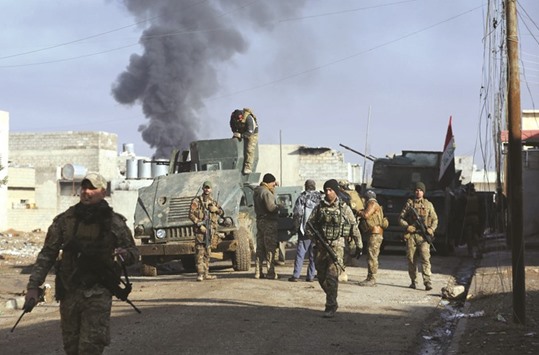
Iraqi pro-government forces advance in Mosul’s southeastern Sumer neighbourhood yesterday, during an ongoing military operation against Islamic State (IS) militants.