


Egypt will ask the International Monetary Fund’s executive board within a day or two to consider its $12bn loan request, Finance Minister Amr El-Garhy said, after the central bank freed the pound’s exchange rate to help spur investments and ease a dollar crunch.
The push to finalise the loan comes as Egyptian banks began freely trading foreign exchange on the interbank market this week for the first time. The pound weakened 3.6% yesterday to 16.75 per dollar at the National Bank of Egypt, the country’s largest lender. The currency has lost nearly 50% of its value since it was floated on November 3.
A total of $15.8mn changed hands on Sunday - a level which was “low but expected given that banks have been starved of foreign currency for such a long time,” according to Reham ElDesoki, senior economist with Dubai-based Arqaam Capital. Volumes “should go up with time,” she said. “The central bank will probably wait and see how the system works in terms of self financing” before deciding whether to inject liquidity into the market.
Attention now turns to the IMF, which had tied the loan’s final approval to Egypt liberalising its exchange rate and cutting energy subsidies, both carried out last week. Egypt sees the accord as key to shoring up investor confidence in an economy that’s struggled since the 2011 ouster of then-President Hosni Mubarak. Economists have said the measures could stoke inflation that for months has been at its highest level this decade.
The pound’s 12-month non-deliverable forwards plunged 8.6% to 18.3 per dollar.
With tourists deterred by an insurgency in the country’s Eastern Sinai, Egypt has relied on billions of dollars of aid from its Gulf allies since the removal of Mubarak. The support has dwindled amid the drop in oil prices, prompting the government to turn to the IMF for help.
Removing the fixed exchange rate represented a major step for the central bank as it struggled to reel in a black market where the dollar was trading at almost twice its official rate. The spread between the two rates, coupled with the shortage of hard currency, had suppressed business. The regulator also raised key interest rates 300 basis points. After the flotation, the pound slipped by as much as 45%.
The flotation carries an inflationary risk – one further augmented by the government’s announcement hours later that it was raising fuel prices by as much as 47% effective November 4. The step further frustrated many in the nation of more than 90mn who have been grappling with price increases and shortages in some key commodities such as sugar.
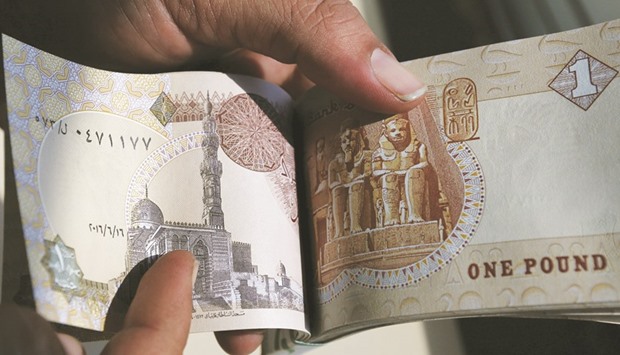
A man counts Egyptian notes outside bank in Cairo. The push to finalise the IMF loan comes as Egyptian banks began freely trading foreign exchange on the interbank market this week for the first time yesterday.