


The world’s biggest liquefied natural gas traders will be lining up for what may be the last billion-dollar payday from Egypt.
Egypt is seeking about 120 LNG cargoes for next year, worth about $2.4bn at current spot prices in Singapore. That may be “the last big tender” if recent discoveries in the North African nation start production in 2018, according to Maggie Kuang, an analyst in Singapore at Bloomberg New Energy Finance.
The most populous Arab country’s soaring demand and short-term volume requirements helped offset slumps in top LNG importer Japan amid a global glut, benefiting traders from Trafigura Group to Noble Group as well as producers such as Algeria’s Sonatrach.
From 2018, Egypt may start regaining self-sufficiency in gas as the super-giant Zohr field starts, leaving traders to seek other demand outlets.
“This is a big tender in a weak market, and I am sure that there will be considerable interest,” David Ledesma, an independent energy consultant with 32 years of experience, said by e-mail. “As Zohr starts up, Egypt’s LNG import requirements may reduce, but it always takes time for new gas supply.”
Egyptian LNG demand will climb 5% next year after a 60% jump in 2016 before dropping 40% from current levels in 2018, according to Bloomberg New Energy Finance. By 2021, the nation may stop LNG imports started last year and two export plants may resume operations after gas was diverted to meet domestic power demand, according to the Oil Ministry and the Cairo-based Al Borsa newspaper.
Engie SA, the French energy company that has a contract to receive 3.6mn tonnes of LNG a year from Egypt, doesn’t expect the country to resume exports anytime soon, Philip Olivier, chief executive officer of the company’s global LNG business, said last Wednesday at a conference in Singapore. Exports could return in the long term as new projects come online and potentially gas production from Cyprus is tied into the plants, he said.
State-run Egyptian Gas Holding Co in June said it will need about 120 cargoes next year. The tender is expected to be issued in the next week, New York-based World Gas Intelligence said on September 21. EGAS, as the company is known, didn’t reply to calls seeking comments.
Egypt’s Oil Ministry has said it plans to in the fourth quarter pay dues owed to foreign oil companies as the nation struggles to shake the economic and political turmoil that followed former president Hosni Mubarak’s ouster in 2011. Oil and gas majors may be more cautious than trading houses to participate because of the credit risk involved, said Andy Flower, an independent energy analyst.
Future imports will depend on how quickly Eni SpA develops Zohr, which the Rome-based company discovered last year and said was the largest gas find in the Mediterranean Sea. It will start drilling a sixth well and production is set to begin by the end of 2017. It also made a separate “significant” discovery with BP this year.
“Egypt has been blessed with significant natural gas reserves and the days of significant LNG imports is approaching its end,” said Claudio Steuer, director at SyEnergy, a Poole, England-based energy consultancy, who was involved in gas master planning for Egypt in the late 1990s. “Producing Zohr and other assets has some technical challenges” that international oil companies can address.
The waning of Egyptian imports would come just as the market glut is expected to fade following a 50% jump in global liquefaction capacity. The International Energy Agency expects supply and demand to align by 2021.
LNG imports became attractive for nations such as Egypt after prices fell 61% over the past two years. Future choices will depend on prices, said Anne-Sophie Corbeau, a research fellow at Riyadh-based King Abdullah Petroleum Studies and Research Center.
“The price level is key,” she said. “If LNG is too expensive, in absolute terms and relative to domestic gas production, then they will probably phase imports out.”
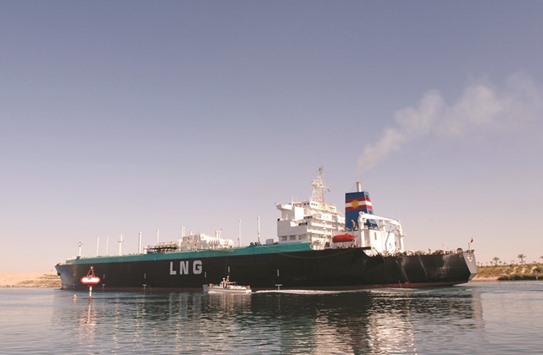
An LNG tanker sails on the Suez Canal in Ismailia (file). Egypt is seeking about 120 LNG cargoes for next year, worth about $2.4bn at current spot prices in Singapore.