


Russia launched a second day of air strikes against Syrian militants from an Iranian air base, rejecting US suggestions its co-operation with Tehran might violate a UN resolution as illogical and factually incorrect.
State Department spokesman Mark Toner on Tuesday called the Iranian deployment “unfortunate,” saying the United States was looking into whether the move violated UN Security Council resolution 2231, which prohibits the supply, sale and transfer of combat aircraft to Iran.
Russia bristled at those comments yesterday after announcing that Russian SU-34 fighter bombers flying from Iran’s Hamadan air base had for a second day struck Islamic State targets in Syria’s Deir al-Zor province, destroying two command posts and killing more than 150 militants.
“It’s not our practice to give advice to the leadership of the US State Department,” Major-General Igor Konashenkov said in a statement.
“But it’s hard to refrain from recommending individual State Department representatives check their own logic and knowledge of basic documents covering international law.”
Moscow first used Iran as a base from which to launch air strikes in Syria on Tuesday, deepening its involvement in the five-year-old Syrian civil war and angering the United States.
Russia’s use of the Iranian air base comes amid intense fighting for the Syrian city of Aleppo, where rebels are battling Syrian government forces backed by the Russian military, and as Moscow and Washington are working towards a deal on Syria that could see them co-operate more closely.
Russia backs Syrian President Bashar al-Assad, while the United States believes the Syrian leader must step down and is supporting rebel groups that are fighting to unseat him.
Russian Foreign Minister Sergei Lavrov said yesterday any US dismay over Moscow’s military co-operation with Iran should not distract from efforts to realise the US-Russia deal on co-ordinating action in Syria and securing a ceasefire.
Lavrov said there were no grounds to suggest Russia’s actions had violated the UN
resolution, saying Moscow was not supplying Iran with military aircraft for its own internal use, something the document prohibits.
“These aircraft are being used by Russia’s air force with Iran’s agreement as a part of an anti-terrorist operation at the request of Syria’s leadership,” Lavrov told a Moscow news conference, after holding talks with Murray McCully, New Zealand’s foreign minister.
Iran and Russia are the two staunchest backers of the regime of President Bashar al-Assad, with Tehran commanding thousands of troops fighting for him on the ground while Russia provides airpower.
Both oppose calls for Assad to step down as a way of resolving the conflict that has killed more than 290,000 people since it erupted in March 2011.
Meanwhile, a top Iranian lawmaker confirmed yesterday that Russian warplanes are using an airbase on its territory.
The operations have been authorised by Iran’s Supreme National Security Council and are based on a deal between Iran, Russia, Syria and Iraq, the head of parliament’s national security committee,
Alaeddin Boroujerdi, said in comments carried by Iranian state news agency Irna.
He specified that the jets were using the Nojeh airbase in Iran’s western Hamadan province to refuel.
Hamadan is much closer to positions of the Islamic State extremist group than the base Russia had previously been using, Khmeimim, in coastal northern Syria.
“The matter should be considered a strategic and necessary co-operation in the fight against terrorism,” said former Iranian foreign minister Ali Akbar Velayati, who is currently a foreign policy consultant to Iran’s supreme leader.
The co-operation isn’t in violation of UN resolutions and has been approved by Syria, he added.
Earlier, the speaker of Iran’s parliament, Ali Larijani, denied that Russian warplanes were using Iranian territory.
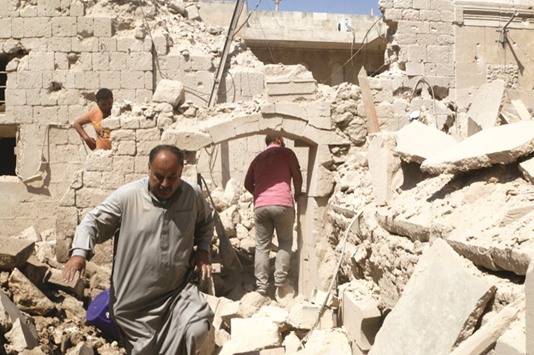
Residents inspect their damaged homes after an air strike on Old Aleppo, Syria.