


Qatar’s initiatives to increase private sector participation in national economic development will enhance private investments and trigger private sector demand for credit, according to HE the Qatar Central Bank Governor Sheikh Abdulla bin Saoud al-Thani.
Given its fiscal buffers, the government has committed to pursuing infrastructure plans, while at the same time prioritising its spending plans to “improve investment efficiency and taking initiatives to increase private-sector participation”, he said.
Reflecting this strategy, private investment is expected to grow - and with it, private sector demand for credit - in line with the robust non-hydrocarbons sector growth, Sheikh Abdulla said in an interview with the Oxford Business Group.
As Qatar progresses towards the completion of the Strategic Plan for Financial Sector Regulation 2013-16, the country remains satisfied with the progress that has been made.
A risk-based micro-prudential framework, based on Basel III standards, has been developed, and existing macro-prudential oversight has been enhanced. Investor participation in the market has been increased, with foreign investors now allowed to hold up to 49% of shares in listed companies, he said.
Overall, the financial sector architecture continues to be developed and strengthened to ensure financial stability. While residual tasks remain to be completed, the focus of the financial strategy will continue to be on development with stability.
In this regard, enhancing macro-prudential oversight and further developing the financial sector architecture and markets will continue to be priorities ahead, Sheikh Abdulla said.
Given the QCB’s objectives, he said, the evolving macroeconomic and liquidity conditions guide its implementation of monetary policy. In view of the persistence of low oil prices and the consequent moderation in public sector deposit growth, the QCB has more recently been actively managing liquidity to ensure comfortable liquidity in the system, thereby stabilising interest rates.
This, in turn, is expected to facilitate the adequate flow of credit to productive sectors in a cost-effective manner in support of economic diversification.
The QCB has actively been managing liquidity in the system to ensure stability of interest rates and the adequate flow of credit to productive sectors, Sheikh Abdulla said.
Moreover, the QCB has kept its main policy rates unchanged since August 2011 - the Qatar Money Rate (QMR) deposit rate at 0.75% and QMR lending/repo rates at 4.5% - maintaining its easy monetary policy stance to support growth with stability.
“Going forward, the QCB will continue to monitor evolving domestic and global developments and respond flexibly as necessary,” Sheikh Abdulla told the Oxford Business Group.
Harmonisation of the regulatory and supervisory frameworks for financial institutions within the state is under the mandate of the Financial Stability and Risk Control Committee (FSRCC), he said.
Insofar as it pertains to the QCB’s implementation of Basel III requirements on capital, the applicability is to national conventional and Islamic banks.
The liquidity measures - the liquidity coverage ratio and net stable funding ratio - are made applicable to both national banks and branches of foreign banks.
“These requirements are only applicable to the banking sector; however, instructions to the insurance industry are currently being revised to ensure that they are consistent with international standards and principles, especially with regard to Basel III,” Sheikh Abdulla said.
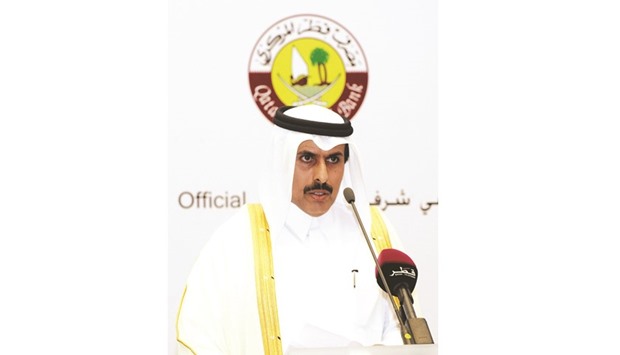
HE Sheikh Abdulla: Actively managing liquidity.