


New York-based Serbian performance artist Marina Abramovic is one of the finest and the most pioneering artists of our time. Stretching the limits of the body and the possibilities of the mind to their very limits, Abramovic has devoted more than 40 years of her inspiring career to demystifying the relationship between performer and audience.
Down in Doha recently to give a talk ‘Performance as Art, Art as Performance’ at the The New York Times’ ‘Art for Tomorrow’ conference, Abramovic swept the audience away with her fascinating insights into people, art and performance. Community takes you through the highlights.
About what performance art means to her, Abramovic said, “I am not about objects. I am all about people, communities, cities and performance art. My definition of performance is that it is a mental and physical construction which is designed to be in an exact place and time where the public enters and then, the energy dialogue between the performer and the public has to happen.
“I would like for my work to function as a constant mirror, so that the public does not see me in their work, but rather themselves. That’s the fundamental thing.”
In 1974, Abramovic delivered one of her best-known performances ‘Rhythm 0, 1974’. In the six-hour performance at Galleria Studio Morra in Naples, Abramovic allowed herself to be manipulated by the public in any way they chose, using 72 objects laid on a table. While some of those objects were for pleasure, some were for pain; the dangerous ones included a loaded gun, pocket knife, scalpel, hammer, saw, metal pipe, metal spear, and axe.
Abramovic said, “It was an experiment and I was young and foolish. But this was an experiment to see what if I gave to the public the complete opportunity to do whatever they want – how far could they go? I ended this experiment with the knowledge that the public can actually kill you. I understood that you can take something best out of the public, or you can completely transform them into something else and leave the spirit, which took me almost 40 years of my career to do.”
For Abramovic, it was an extremely challenging piece of performance art to pull off because she wasn’t in control, the audience was. The performance had ended with she holding a loaded gun against her own head, tears in her eyes, her blouse ripped open, and her head bleeding from a wound. “In the beginning, the public would give me a rose, but later on they would stick pins in my body, use the pistol, or carry me around. It was a very violent experience,” Abramovic explained.
Explaining how artists must be servants of the society, and not just servants, but must bear responsibility, Abramovic referred to a statement by German museum director Alexander Dorner that she said inspires her: The new type of art institute cannot merely be an art museum as it has been until now, but no museum at all. The new type will be more like a power station, a producer of new energy. “And that’s where I am actually right now,” she said.
Elaborating on The Abramovic Method, a series of exercises she designed over the course of 40 years to explore boundaries of body and mind, she said, “It’s very simple. When you go to the museum or the art gallery, you enter into a space that has lockers. In these lockers, you have to keep your telephone, computer and watch. This is the moment when you give yourselves a special freedom of being all alone without technology. Don’t get me wrong – I am not against technology. Technology is not wrong but our approach towards technology is wrong.”
“So as you enter this new place, you get headphones. These (noise-cancelling) headphones are incredible important,” Abramovic continued, “The moment you block sound, you are together with everybody else in the room but at the same time, you are alone. You can hear your heart beating. You can actually be in this space which you, all the other times, avoid.”
Exercises that feature in The Abramovic Method are very simple such as slow walk, counting rice, standing on a platform with eyes closed, looking at colours, mutual gaze, etc.
“I don’t think we need art in nature. Nature is so perfect already, without us. We need art in cities where human beings don’t have any time. In the cities that are polluted, in the cities that have too much noise. We have to take experience from the nature and translate it into the cities. I always believe that the function of art is a function of bridge; to bridge different people from different social backgrounds, religious beliefs, and races. But it’s also about communication between the physical world and the spiritual world, or simply between two human beings,” she says in a video that she presented as part of her talk.
Abramovic says she eventually understood that she must “give tools to the public to experience their own selves.” She explained, “I have to be like a conductor because I am always performing in front of the public, engaging with them. The public is my mirror and I am the mirror of the public, too. Everybody has trauma, loneliness, fear of death, and pain. I am giving a part of myself and they give me a part of their selves. The only thing they can understand on a much profound level what performance is, is they make their own personal journey.”
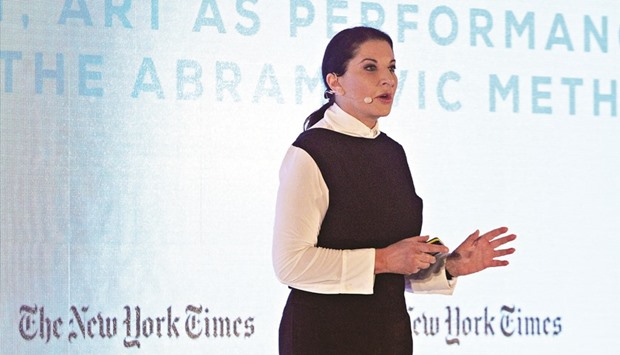
INSIGHTFUL: Abramovic gives her presentation at the ‘Art for Tomorrow’ conference in Doha.