


The Qatar Biomedical Research Institute (QBRI), one of Hamad Bin Khalifa University’s three specialised national research institutes, is holding two unique training courses on Autism Spectrum Disorder (ASD) diagnosis to help improve the healthcare system in Qatar and build the capacity of scientists and medical practitioners in the region.
Upon completion, participants will be certified to use two standardised autism diagnostic tools in both clinical settings and research studies.
The courses are held in collaboration with autism consultants from Cambridge, UK, and cover key approaches to diagnosing autism through the use of interviews, coding, and observation.
QBRI has selected local researchers, autism specialists, and medical practitioners to take part in the course.
Dr Walid Qoronfleh, director of the Biotechnology Development, QBRI, noted: “Local participants who successfully complete the courses will be equipped to diagnose autism spectrum disorder. In fact, this training more than doubles the number of practitioners in the country trained to do so.”
As part of its effort to establish a regional autism research consortium, QBRI has also invited three representatives from leading autism research centres in Saudi Arabia, Oman, and Sudan.
Across the Arab world, there is limited data about autism - something that QBRI researchers are keen to rectify.
Dr Fouad Alshaban, senior scientist at QBRI and organiser of the courses, commented: “QBRI is leading two major projects to assess the prevalence of autism spectrum disorders in Qatar. Successful collaboration with researchers in the Cleveland Clinic and Oregon Health and Science University has led to the development and validation of the first-ever Arabic language questionnaire for autism screening.”
He said: “We expect 5-8% of the children we screen as part of our research project to score positive on an initial test. They then need further assessment to make a final diagnosis. This training gives more people the certified skills to conduct such further assessment. Therefore, we need more trained and certified clinicians and researchers to support autism research and clinical services in Qatar.”
Dr Hilal Lashuel, executive director, QBRI said: “QBRI is committed to establishing a regional centre of autism research excellence that will contribute to improving early diagnosis, intervention and treatment of autism spectrum disorders. We plan to achieve this through the development of interdisciplinary research programmes on the discovery of novel genes that cause or contribute to the development of autism, elucidation of novel disease mechanisms and the integration of novel technologies and innovation in eye tracking, speech recognition and robotics to improve early diagnosis and develop innovative intervention and treatment strategies for ASD.”
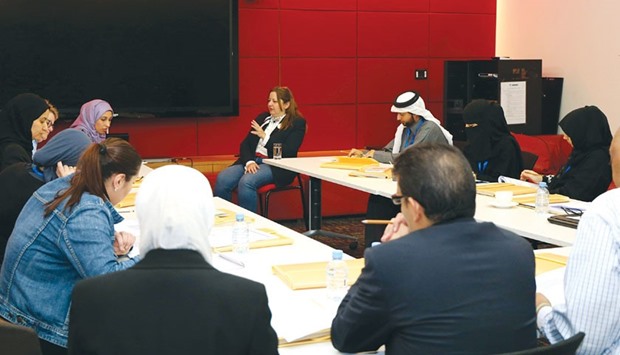
Participants attend a training session.