


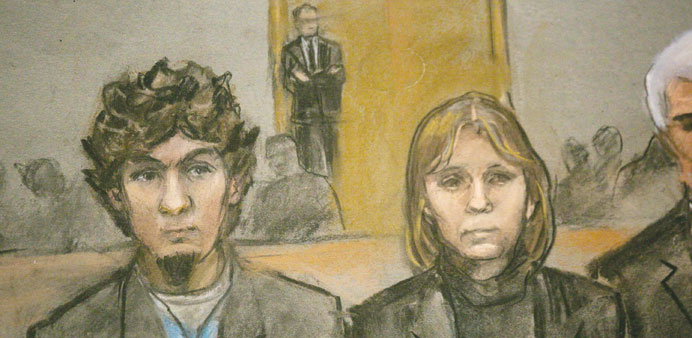
A courtroom sketch shows Boston Marathon bombing suspect Dzhokhar Tsarnaev, left, and his defence team as the verdict is read at the federal courthouse in Boston, Massachusetts, on Wednesday. Tsarnaev was found guilty of the 2013 bombing that killed three people and injured 264 others.
By Jennifer Smith/Boston/DPA
The running of the next Boston Marathon was just 12 days away when the federal jury found Dzhokhar Tsarnaev guilty of all 30 charges - including 17 charges that carry the death penalty - in the 2013 bombing of the iconic race.
After the verdicts were pronounced on Wednesday, residents and officials were conflicted about the appropriate punishment. Massachusetts, after all, has banned the death penalty since 1984 for in-state cases.
Federal prosecutors in the US, however, can ask for the death penalty and jurors were closely screened for their openness to imposing the death penalty if the law warrants it.
Many in Boston were pleased by the verdict, reached after more than 11 hours of deliberation. The jury held Tsarnaev responsible for the violent rampage two years ago that left a city shaken, four dead and more than 260 others injured or maimed.
It was the worst terrorist attack on the US since the September 11, 2001 Al Qaeda attacks on New York and Washington that killed 3,000.
Tsarnaev’s older brother, Tamerlan, was killed in a shoutout during a standoff with police.
Bombing survivor Karen Brassard said Tsarnaev was fully responsible for taking part in the attacks, though his defence team painted the then-19-year-old as a follower of what was ultimately his older brother’s plot.
“He was all in,” Brassard said. “He’s a grown man and made choices knowing what the outcome could be.”
And the outcome could ultimately be death. Tsarnaev’s attorneys have frankly conceded his guilt in the bombing and subsequent manhunt in the hope of avoiding execution.
“I am thankful that this phase of the trial has come to an end and am hopeful for a swift sentencing process,” Boston mayor Martin J Walsh said in a statement.
“The incidents of those days have forever left a mark on our city,” he said.
Samantha Gross, 19, a student at Boston University, said she was trying “to remain unbiased in this trial”. She said whether or not the death penalty is warranted “depends on the magnitude and the impact the crime has on people and on the city”.
The manhunt for the Tsarnaev brothers locked down one of the East Coast’s most important port cities for four days.
Nabil Agba, 27, moved to the area seven years ago from Morocco. He was working as a cab driver when the bombing occurred and helped people pile into the vehicle to get them away from the chaos.
“They were scared, and they were runners so they didn’t have any money on them,” he said. “I gave a lot of free rides that day.”
As a Muslim, he is horrified by the violence carried out in the name of his faith.
“Any religious scholar would tell you that killing innocent people is wrong,” he said. In the face of the verdict, he strongly supports the death penalty.
Many were reluctant to speak publicly on the trial, which remains at the forefront of many residents’ minds.
A 36-year-old South Shore woman, who has lived in the state for most of her life and whose husband works in Boston had followed the trial closely.
“I was not surprised by the verdict,” she said, asking that her name not be used. “I’m happy about it.”
Though she is personally opposed to the death penalty and “would rather he not be executed”, she pointed out that the marathon has always been a prominent part of Boston’s history, a public holiday that brings great pride to the city - and families with children to watch.
State and city officials supported the verdict but were careful to withhold judgement on sentencing.
Massachusetts Governor Charlie Baker said: “I applaud the verdict rendered by the jury in the Marathon bombing case, and I hope this brings some degree of closure to those individuals and their families whose lives were changed forever on that horrific day.”
Closure is an elusive goal, and one that Brassard said in broadcast comments will not be accomplished through a trial.
“It’s not something that you’ll ever be over ... but we’re all gonna move on with our lives and we’re going to get back to some sense of normalcy, hopefully, when all this is done,” she said.