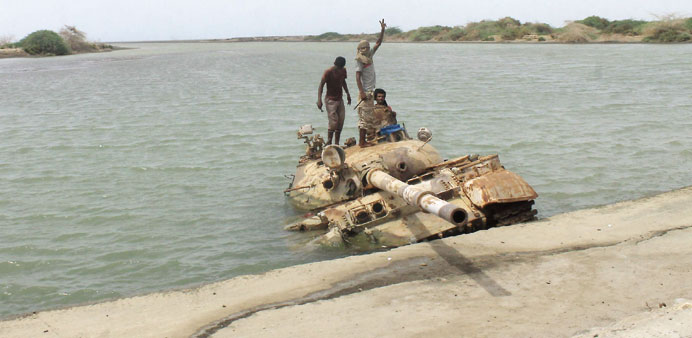
Yemeni pro-government forces stand on a drowning tank they said belonged to Houthi fighters on the road to the town of Shaqra, in Abyan province on Tuesday. Saudi-backed forces loyal to the exiled government announced on Monday the recapture of Abyan province in a southern offensive that has seen key gains against the Shia Houthi rebels.
Reuters/London
Rubbish piling up on the streets of Yemeni towns is helping the spread of dengue fever and malaria, a charity employing local people to clear up the filth said yesterday, as fighting, baking heat and a lack of food and water add to their hardships.
Rubbish lying in the streets has contaminated soil and water and attracted infectious pests, Mercy Corps said. Mosquitoes carrying dengue fever and malaria breed and lay eggs in puddles.
At least 8,000 people in the port city of Aden have contracted dengue fever since the present crisis began five months ago, cases of typhoid have been recorded and there are reports of malaria.
The US-based charity pays local youths a daily wage to remove the waste and dispose of it safely, giving them paid work and improving living conditions for other city residents.
“People are glad to see their streets cleaner,” said Jonathan Bartolozzi, a Mercy Corps spokesman.
Since fighting between Iranian-allied Houthi rebels and a Saudi Arabian-led military coalition broke out in March, the World Health Organisation says that more than 4,300 people have been killed and over 22,000 wounded.
The country lacks basic supplies, and 80% of the population needs help to meet their basic needs - food, water, healthcare and shelter, according to the UN Development Programme.
“At some moments, I felt that the conflict in Yemen is much more of a war against civilians than a war against armed groups,” Teresa Sancristóval, head of emergencies in Yemen for medical charity Medecins Sans Frontieres (MSF), said on Tuesday.
The price of water has doubled in the last month, forcing many families to spend one-third of their income on water, she said in a statement, adding that Sanaa is predicted to be the first capital in the world with no access to clean water.
The city of Aden has seen heavy fighting and temperatures as high as 50 Celsius. Many health facilities have been closed, Bartolozzi said.
“There were stories of people literally having to find their way to get a drip and get home-based treatment from anyone they might know who might have had any kind of nursing training,” he said.
Peter Maurer, president of the International Committee of the Red Cross, said on Tuesday that Yemen was “crumbling”.
“Every family in Yemen has been affected by this conflict,” he said after a three-day visit to the country.