


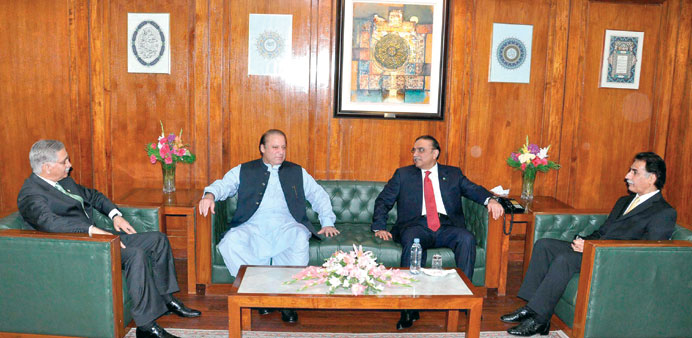
Pakistan’s Senate chairman Syed Nayyer Hussein Bokhari, Prime Minister Nawaz Sharif, President Asif Ali Zardari and Speaker of National Assembly Sardar Ayaz Sadiq meet before a joint session of Parliament in Islamabad yesterday.
|
In an effort to persuade the US to cease drone strikes on Pakistani territory, the new government of Prime Minister Nawaz Sharif will offer to eliminate ‘terrorist sanctuaries’ from the tribal areas itself, media reports revealed here yesterday. |
A senior leader of the ruling Pakistan Muslim League-N engaged in foreign policy matters was quoted by Express Tribune newspaper as saying that Sharif will soon inform Washington that his government is ready to address US concerns pertaining to terrorist threats in Pakistan’s tribal region in return for the cessation of the CIA-piloted drone campaign.
He reiterated that the government is principally opposed to unilateral strikes on Pakistani territory and hence would urge Washington to put an end to the campaign.
“But having said that drone attacks must not be seen in isolation,” said the ruling party member, who asked to remain anonymous. “There are reasons for drone attacks and we have to address those.”
He explained that the newly-elected PML-N government was working on a new anti-terror strategy that not only opposes drone attacks but all elements violating the country’s sovereignty by keeping ‘safe havens on our territory.’
Last week, in his victory speech soon after his election as the country’s Prime Minister, although Sharif called for an immediate end to drone attacks, he made it clear that Pakistan must also address the concerns of others.
“We must learn others concerns about us and express our concerns about them, and find a way to resolve this issue,” the prime minister had said in his address to the National Assembly.
Pakistan and the US will hear each other’s concerns later this month when Secretary of State John Kerry travels to Islamabad. This will be Kerry’s first trip to Pakistan after the installation of a new government in the country.
“We are confident that we will be able to resolve the issue of drones with the US,” said another official. He said Prime Minister Sharif, after consultations with all stakeholders, will announce a policy statement making it clear that the government would not allow its territory to be used against any other country.
However, it is not clear how the new government plans to achieve that objective.
The country’s security establishment, despite carrying out operations in other tribal agencies, has in the past remained reluctant about launching a full-scale military offensive against alleged terrorist hideouts including those alleged to belong to the Haqqani network in the North Waziristan Agency.
Sources said a clearer picture would emerge after a high-level civil-military huddle to discuss important national security issues.
The government, on the other hand, is quite confident that it can convince the US to stop drone attacks if its ‘genuine concerns’ are addressed.
In new policy guidelines approved recently by President Barrack Obama, the US has set certain conditions for drone use. One such condition is that US will use drones only when the host country is either incapable or lacks the will to eliminate the specific terror threat.
“This means that if we can act decisively against such specific targets then the US has no justification for drone use,” the official said.
“If the new government does bring a policy shift and act against all foreign militant groups finding refuge in tribal areas, this will have far-reaching implications,” commented international affairs analyst Dr Ishtiaq Ahmed, who is currently Jinnah fellow at the Oxford University.