


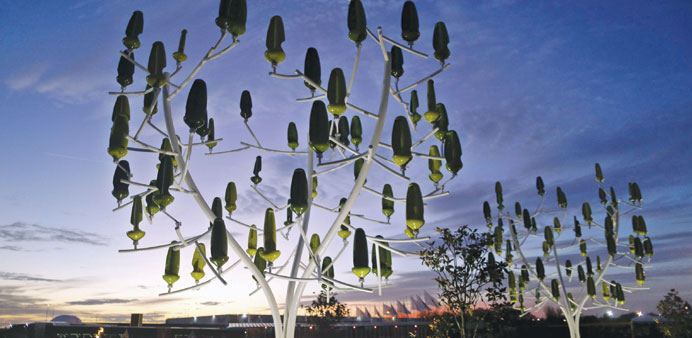
Two “wind trees”, a renewable energy innovation, are pictured at the sunset during the World Climate Change Conference 2015 (COP21) at Le Bourget, near Paris.
By Jessica Camille Aguirre/DPA/Paris
At the entrance to the Paris conference halls where negotiators haggled for two weeks over an agreement to limit greenhouse gas emissions, there are a couple tree-like structures.
The tall metal finger-like structures branch out to hold dozens of spinning, half-cylinders resembling leaves.
The contraptions are producing energy with wind power, being used for the conference’s sizeable demands. This feat, prodded by the first universal action plan on climate passed by delegates from nearly 200 countries on Saturday, will soon become one of the most common means of powering electricity grids everywhere.
It took two decades of UN talks to get the pact adopted over the weekend that will push a massive global transition to renewable energy like wind. In that time, all the other ways of fueling modern lives - oil, coal, gas - have continued to be used and to contribute to global warming trends.
And the world is nearing its limit, in terms of being able to change fast enough to keep warming temperatures from rising to such a degree that they cause irreversible tipping points, like massive Greenland ice melt.
“We will not be able to continue burning fossils fuels. Even if we balanced with best forest management possible, we will still have to lower emissions drastically,” said Joeri Rogelj, of the International Institute for Applied Systems Analysis.
Rogelj was referring to specific parts of the climate agreement that set out the course for global emissions - a highly contested set of sentences meant to lay out the long-term plan.
They say that countries will keep global temperature increases to less than 2C, and will do so by reaching a peak of greenhouse gas emissions as soon possible and finding a balance between “anthropogenic emissions by sources and removals by sinks” in the second half of the century.
Sinks are natural or technology-induced withdrawal of emissions from the atmosphere.
Among scientists who read the text, there was broad consensus that the wording implied that there would have to be zero net emissions by between 2050 and 2100.
“It is in line with the scientific evidence we presented of what would have to be done to limit climate risks such as weather extremes and sea-level rise. To stabilise our climate, carbon emissions have to peak well before 2030 and should be eliminated as soon as possible after 2050,” said John Schellnhuber, director of the Potsdam Institute for Climate Impact Research.
“Technologies such as bio-energy and carbon capture and storage, as well as afforestation, can play a role to compensate for residual emissions, but cutting carbon is key,” he said.
Those tactics, along with promoting natural carbon sinks like forests - what Schellnhuber calls afforestation - are meant to be part of the balance after the mid-century, according to the agreement. The question of how much they will play a role or whether the balance - or net zero - will have to come from carbon cuts.
Rogelji says the open-ended nature of the agreement could be positive in allowing for concrete plans to adapt over time, with a view toward emerging technologies but a focus on long-term goals.
Michael Oppenheimer, a geoscience professor at Princeton University, said prospects for many technologies are dim for providing the kinds of large-scale solutions that would be able to make an impact on the balance. Carbon-dioxide removal, for example, is still experimental.
“These things are feasible from a scientific and technical point of view, but whether they can be commercialised is another question,” he said.
Oppenheimer said the best option is still to protect forests from being cut down, saying that improving forest management over the last decade - especially in Brazil - has made a significant dent in emissions.
On a global level, though, the forests can only do so much to combat the gigatons of man-made emissions, and Rogelj says future savings will mostly have to be put toward balancing out non-carbon emissions that are more difficult to cut - like methane produced by rice farming.
Which is why countries will look increasingly to wind power and other renewable energies to bolster one side of the balance. With national emissions plans still short of achieving the agreement’s promises, scientists say a transition will have to start almost immediately.
For that, the deal doesn’t set out specific rules, allowing for peaking to happen over a relatively vague, if constrained, timeframe and without calculating for the rate of transition.
But while the accord could have been more precise from a natural science point of view, Rogelj says, “It really captures the highest possible ambition at this point given the current political reality.”