


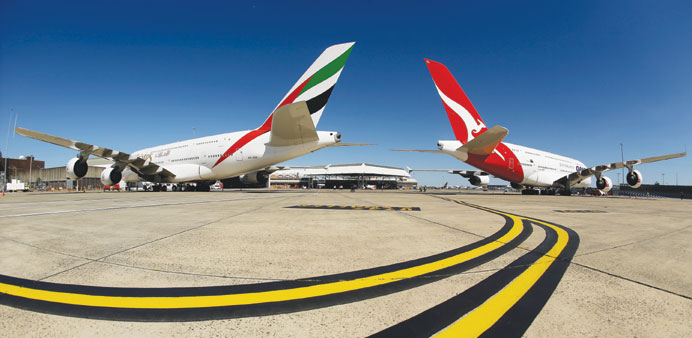
Airbus A380-800 aircraft operated by Emirates Airline (left) and Qantas Airways stand on the tarmac in Sydney (file). An alliance between Australia’s Qantas Airways and Emirates Airline, the world’s biggest carrier by capacity, may have permanently redrawn the Kangaroo route when the two carriers started jointly selling tickets between Europe and Australia in April.
Zawya Dow Jones
|
|
Asian airlines may be quietly giving up the fight on the once-prized Kangaroo route that connects Australia with Europe as intense competition from Middle Eastern carriers and new Chinese entrants crimp profit margins.
For decades, air travellers making the gruelling 25-30-hour journey between Australia and Europe would stop in an Southeast Asian city — most often Singapore or Bangkok — to switch planes or to have their aircraft refuelled. The route was lucrative for many of the region’s carriers that relied on growing transit traffic to build their long-haul networks, with customers preferring their superior customer service against European brands.
While these intermediate stops remain, customers could now transit through a host of other cities with more airlines entering the fray. Particularly, an alliance between Australia’s Qantas Airways and Emirates Airline, the world’s biggest carrier by capacity, may have permanently redrawn the Kangaroo route when the two carriers started jointly selling tickets between Europe and Australia in April.
Singapore this year lost to Dubai in the Middle East as the busiest stop for the Sydney-London route, the most popular Kangaroo link, following the Qantas-Emirates tie-up. The alliance ended a separate 17-year partnership between Australia’s biggest airline and British Airways that connected the two continents using Singapore as a hub.
In October, 55,000 passengers travelling from Sydney to London changed planes in Dubai, up 34% from 41,000 a year earlier, according to data from Amadeus IT Group, which sells software to the airline industry. Yet the overall number of passengers on the route stayed unchanged at about 150,000 during the month, according to Amadeus.
Meanwhile, Singapore’s share of transit passengers on the Sydney-London route fell to 40,000 passengers from 52,500 in October last year.
For passengers, the intense competition on the Kangaroo route has meant lower ticket prices, but for Asian airlines, this resulted in lower yields and profits, prompting many to look elsewhere to drive growth.
“Asian airlines are shifting focus...from Australia-Europe,” said Will Horton, senior analyst at consultancy CAPA-Centre for Aviation. “With the growth in Asia and closer ties between Australia and Asia, there are more opportunities for (Asian airlines) to sell to that market compared to Europe.”
“The Australia-Europe market is certainly changed forever,” he said.
The number of flights from Southeast Asia to Western Europe fell 3.5% so far this year, according to data from OAG, a UK-based industry information provider. The decline in the number of frequencies has been a more pronounced 8.6% from Singapore and 3.1% from Thailand, as airlines reduce flights due to a weaker European economy.
On the Kangaroo route, the fight between the carriers is for a share of a market that isn’t growing. Inbound travel into Australia has grown at about 1% annually in the last five years, according to an earlier report commissioned by Amadeus.
The key challenge for Asian carriers like Singapore Airlines, Cathay Pacific and Malaysian Airline System is “simply the astoundingly luck geography of the Middle East,” said Greg Waldron, the managing editor in Asia at industry publication Flightglobal.
The shorter distance to Europe from Middle Eastern gateways provides far more one-stop connections to European cities from Australia than Asian carriers could, he said, adding that capacity on Middle-East to Australasia rose over five times since 2005 to around 1.6mn seats this year.
Meanwhile, Chinese airlines, which had earlier been mostly domestically-focused, are moving to expand their international network and are building traffic on the Kangaroo route, offering stopovers in Chinese cities.
“The Gulf carriers certainly brought prices down but the big jaw-dropping prices are coming from Chinese carriers, which are using price to stimulate a product the market has largely not experienced before,” said Horton of CAPA.
China Southern Airlines, which started developing Europe to Australasia traffic through its Guangzhou hub last year, offers the cheapest Sydney-to-London return tickets, even while providing extra baggage allowances for coach class passengers, allowing them to each check two bags instead of one.
Cheapest economy class fares for a Sydney-to-London return flight in the second week of January was US$1,995 on China Southern. Emirates and Qantas quoted US$3,059 while British Airways was most expensive at US$3,324, according to online booking agencies.
Fuelled by the strength in many Asian economies, the region’s airlines are instead adding more capacity on domestic and regional flights, as well as focusing on nonstop business travel markets, which command higher revenues, especially from first- and business-class cabins.
Garuda Indonesia chief executive Emirsyah Satar said he sees the robust Indonesian market to drive growth for the flag carrier with both stronger inbound traffic and demand from more Indonesians to travel abroad.
Nonetheless, he continues to want his airline to remain a player in the Kangaroo route, not least because of the prestige factor of the service, noting the company plans to allow economy transit passengers on the route to use the airline’s premium lounges at Jakarta’s airport.