


By Santhosh V. Perumal/Business Reporter
Islamic finance, with estimated assets of $1.8tn, should expand into Asia and the Middle East in a bigger way and explore ways of enhancing the investment universe for demand stability as well as diversify and mitigate risks, according to Qatar Central Bank (QCB).
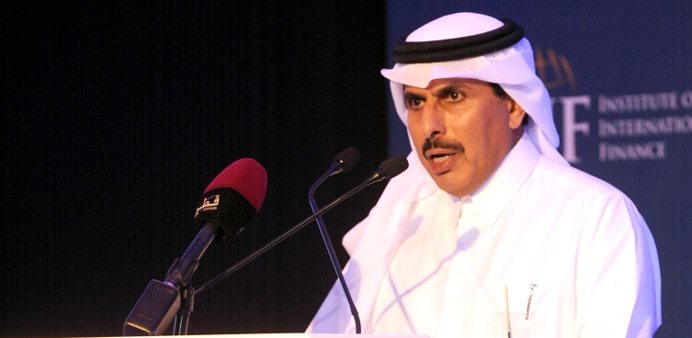
"Islamic finance needs to expand and move into Asia and the Middle East. It will benefit greatly from London, which has become a hub for the Islamic finance," QCB governor Sheikh Abdullah bin Saoud al-Thani told the International Institute of Finance (IIF) Spring Membership meeting that concluded.
The development of Islamic finance industry over the years need further refinement and growth without losing its essence, but was a challenge from a purely economic perspective, he said.
Finding that demographics is still working in the favour of Islamic finance; he said the sector has to become more creative and provide an alternative source of funding for the infrastructure needed to achieve sustainable economic development.
Although efforts are being made to diversify the investment products within the Islamic finance space, Sheikh Abdullah said it remains insufficient and more needs to be done to expand asset classes to meet the needs of a wide range of investors and thus provide stability in the demand side.
"We need to diversify Islamic finance," he said, adding feasibility studies should be made on Islamic equity funds.
On Islamic bonds or sukuk, the second fastest growing segment with 40% growth during 2005-12 with returns higher than that in the conventional space, he said the high growth has slowed due to the complex structure but will change when investors become more aware of Islamic financial instruments.
He said the potential growth for the Islamic finance worldwide requires a legislative framework that would maintain global financial stability.
Sheikh Abdullah said QCB was keen to promote Islamic banks in Qatar, which now has four such lenders -- Qatar Islamic Bank, International Islamic, Masraf Al Rayan and Barwa Bank -- which together account for 25% of the country's banking assets.