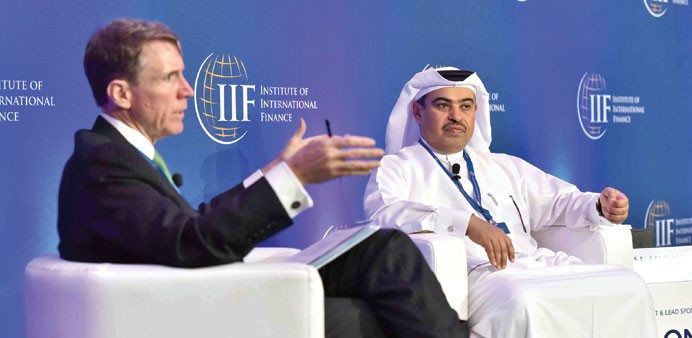
Ali al-Kuwari in a “conversation” with Timothy Adams, Institute of International Finance president and CEO at the ‘2015 IIF Spring Membership Meeting’ in Doha yesterday.
QNB Group will continue its expansion, with a clear focus on strengthening its presence in the Middle East region, Africa and Asia, said CEO Ali Ahmed al-Kuwari.
The international expansion offers QNB Group the opportunity to leverage its in-depth sectorial expertise in oil and gas, construction and infrastructure and capture investment and trade flows across its network in Africa, Asia and the Middle East, al-Kuwari said in a “conversation” with Timothy Adams, Institute of International Finance president and CEO at the ‘2015 IIF Spring Membership Meeting’ here yesterday.
QNB Group aspires to become a Middle East and Africa (MEA) icon by 2017. The overall corporate strategy comprises three pillars — maintain dominant position in Qatar, develop and grow ongoing high return on equity businesses and refocus/ continue international expansion.
Domestically, he said QNB will continue to support the economic development of Qatar and its national strategic projects.
“QNB is committed to invest in Qatar’s future and it continues today with significant financing support deployed on major projects, in addition to its overall small-and medium-sized enterprise (SME) value proposition with sector specific lending programmes,” al-Kuwari said.
On the role of banks and the capital markets in providing the needed financing in the GCC region’s energy and infrastructure sectors, al-Kuwari said, “GCC members have been increasingly important contributors to the world economy and they have successfully positioned themselves as important hubs. The favourable market dynamics, geographical location, logistics infrastructure and the region’s stability compared with its surrounding countries, make it ideal to attract high levels of investment and trade flows.”
The growth in the GCC countries is likely to have reached 3.7% in 2014, while the Qatari economy continues to outperform the rest of the Mena region with an estimated growth around 6.5%, he said.
The banking sector, al-Kuwari said continues to benefit from this favourable macroeconomic environment that has contributed in parallel to deepening the capital markets, an example being the Qatar Stock Exchange.
In Qatar particularly, the implementation of large construction and infrastructure projects complemented with a higher population growth, have boosted the aggregate demand, further stimulating buoyant economic activities across all sectors.
“We believe these present great opportunities for all players such as banks and capital markets to maintain growth momentum across all their activities and further support the economic and social development of Qatar,” al-Kuwari said.
Asked how the recent fall in oil prices would affect the Qatari economy and the banking sector, he said, “The recent fall in oil prices will only have a minor impact on the strong diversification drive of the Qatari economy. According to our latest ‘Economic Insight’, the Qatari economy is projected to grow by 7% this year, on the back of strong public and private investments to diversify the economy away from the hydrocarbon sector. As a result, the banking sector will continue to benefit from these strong tailwinds, with double digit growth in assets and deposits.”
Al-Kuwari expects the normalisation of the United States’ monetary policy to lead to a steeping of the US yield curve.
“This will necessary imply a repricing of financial assets and liabilities, including in Qatar. For QNB’s operations, the normalisation of US monetary policy will imply higher funding costs in the medium term that will need to be offset by a stronger contribution from our expanding international network and greater reliance on fee-based income.
“However, such a scenario is dependent on a recovery from the deflationary environment in advanced economies. If this scenario will not occur, the yield curve will continue to remain relatively flat.”