


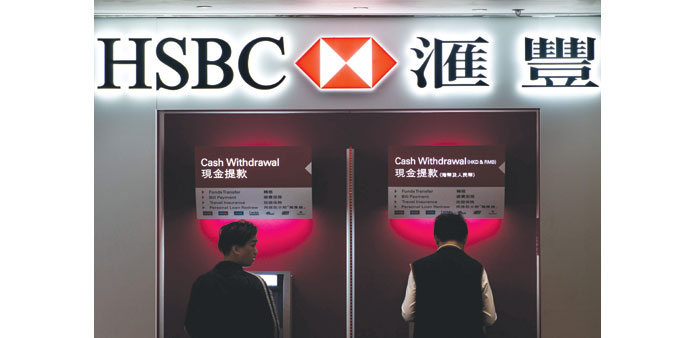
Europe’s largest bank HSBC warned that regulators’ zeal to punish wrongdoing was putting its staff off taking reasonable business risks, as it reported a 12% drop in first-half profit.
HSBC Chairman Douglas Flint yesterday called on international regulators to clarify what they expected of bank staff after recent record sanctions for misconduct, including a $9bn US fine against France’s BNP Paribas, had left them fearful of retribution.
“There’s a creeping concern that staff are clearly very focused on the penalties for getting things wrong and are building risk-aversion into the way they think,” Flint told reporters on a conference call.
“We’ve got to avoid getting to the state where there’s a zero risk tolerance.”
Flint said rules that were too harsh could hurt lending in areas such as wealth management or commercial banking where products can be complicated. Industry sources have warned of unintended consequences from the regulatory clamp down, including the threat that lending will be cut to people or businesses in poorer countries.
Since the action against BNP Paribas for breaching US sanctions, international banks have become hyper vigilant about following new rules, including recent moves by Washington and Brussels to freeze some Russian state-controlled firms out of western capital markets.
HSBC was fined a record $1.9bn in 2012 for breaching US sanctions on money laundering in Mexico and since then has pulled out of business areas and countries, including Panama, to cut the risk of future problems.
The bank said it is spending about $800mn a year more than in 2011 on compliance across its operations in 74 countries.
HSBC and its rivals still face the risk of future fines and legal costs from ongoing investigations, including a global probe into alleged manipulation in the foreign exchange markets.
Under new UK rules, the bank also has to separate its UK retail operations from its riskier investment banking arm and yesterday it warned of a substantial one-off cost to do that.
Chief executive Stuart Gulliver said the split would also cost hundreds of millions of pounds each year, without giving a precise figure.
Lost revenues from closing businesses and a slowdown in investment banking pushed HBSC to a 12% drop in pretax profits in the six months to the end of June to $12.3bn, just below an average forecast of $12.5bn from 15 analysts polled by the company.
Overall, revenue dropped 9% to $31.2bn, including disposals.
Replacing lost revenues is one of the biggest challenges for HSBC. Gulliver said they should pick up strongly about six months after interest rates in major markets rise. HSBC expects UK rates to start rising in the fourth quarter of this year and in the first half of 2015 in the US.
HSBC is more geared to the benefit of higher interest rates than rivals because of its big deposit base, liquid balance sheet and relatively conservative risk appetite, analysts say.
A big rise in rates could add billions of dollars to its top line; HSBC estimates a 25 basis point rise across a range of rates would lift annual income by almost $1bn a year.
The prospect of such a boost helped drive HSBC’s shares up 2.75% after initially dropping as much as 2% when the results were first announced yesterday.
“I think resilience is the word. Gulliver is signalling he thinks rates will move this year, US rates first half of next year. Well that’s got to be good for margins, that’s the one thing that will get this stock moving,” said Numis analyst Mike Trippitt.
Gulliver is in the second phase of a turnaround plan for HSBC that began in 2011, aiming to make the bank simpler, more efficient and able to deliver better returns and dividends for shareholders.
The strategy has helped boost the bank’s defences against future losses with its common core tier one equity ratio, a key measure of financial strength, rising to 11.2% from 10.8% at the end of last year and well above the regulatory minimum of 7%.
Senior
Senior Plc, a maker of parts for aircraft and automobiles, said its group chief executive, Mark Rollins, would retire in the first half of 2015.
The FTSE-250 company’s shares fell as much 2.8% on the London Stock Exchange yesterday.
Rollins, 52, has spent 17 years at Senior, including seven as chief executive. He said the recruitment process for a successor was already underway.
In a note to research analysts, Rollins said he was a strong believer in fresh blood at the top.
Jefferies analyst Andrew Douglas told Reuters that Rollins’ exit had created uncertainty in the minds of investors.
“We are disappointed that... Rollins is due to retire in 1H15 and expect the uncertainty to impact the shares in the short-term until a successor is found,” Investec analyst Thomas Rands wrote in a note.
Senior also reported first-half earnings yesterday.
The maker of hydraulic parts, seal assemblies and aircraft wall panels said its pretax profit rose to £45.1mn ($75.9mn) for the six months ended June 30, from £37.1mn last year.
Revenue was nearly flat at £400.4mn, hurt by a stronger pound. The company generated more than half its revenue from North America in the first six months of the year.
A strengthening sterling has dented first-half earnings at a number of British industrials.
The pound has risen 3.3% against the dollar in the first-half of the year to June 30.
Rollins told Reuters that he expected Senior’s full-year profit to fall by about 7% due to the rising pound.
The company’s aerospace division, which accounts for two-thirds of its total revenue, has been benefitting from higher demand from the commercial aviation sector.
The commercial aviation business grew to about 39% of group sales in the first half, from 34% a year earlier, driven primarily by a 7% rise in aircraft deliveries by Boeing and Airbus, Senior said.
Net orders from the aviation giants increased 22%, with their combined order book rising to 10,783 aircraft.
Michael Kors
Michael Kors Holdings Ltd, known for its trendy handbags and watches, said it expects margins to shrink for the year as it invests more to open stores in Europe and increases the number of shops it has in department stores.
Michael Kors’ shares fell more than 7% in early trading. They rose as much as 12% before the opening bell yesterday after the company reported another quarter of strong revenue growth.
Michael Kors, controlled by fashion designer and former “Project Runway” TV show judge Michael Kors, is one of the fastest-growing companies in the luxury and so-called “affordable luxury” segments.
Revenue jumped 43% to $919.2mn in the first quarter ended June 28, driven by strong sales of handbags, watches and footwear in North America and Europe.
Michael Kors has posted sales growth of 40% or more in almost every quarter since going public in December 2011. But it is now having to spend heavily to maintain that momentum.
The company, started as an American luxury sportswear house in 1981, has overtaken closest rival Coach Inc in market share as its core customers — women between the age of 20 and 35 — snap up its trendy accessories.
The company’s handbags sell for $200 to $3,000, with most selling for $500-$700, while its oversized watches are priced between $150 and $550.
Apart from its own standalone stores, the company sells in department stores such as Macy’s and Bloomingdale’s.
Michael Kors said in May it expected the cost of opening new stores in Europe to depress gross margins in the next few quarters.
The company said yesterday it expects gross margins to decline by about 50 basis points and operating margins by about 200 basis points in the current quarter.
Michael Kors had an operating margin of more than 30% in the first quarter. Gross margin expanded 20 basis points to 62.2%.
“... We never believed that a 30% operating margin was a sustainable margin for the company ...,” chief executive John Idol said on a conference call.
Michael Kors said it expects full-year earnings of $4.00-$4.05 per share on revenue of $4.25bn to $4.35bn.
It had previously forecast earnings of $3.85 to $3.91 per share on revenue of $4bn to $4.1bn.
Michael Kors’ revenue from North America, its biggest market, rose 30% to $718.9mn in the first quarter.
Same-store sales increased 24.2%, with a growth of 18.7% in North America. Sales in Europe more than doubled to $185.5mn and now make up 20% of total sales.
“In the long term, we continue to believe ... this market can generate revenue of approximately $1.5bn for Michael Kors,” Idol said.
Net income rose to $187.7mn, or 91¢ per share, from $124.9mn, or 61¢ per share, a year earlier.
Analysts on average had expected earnings of 81 cents per share on revenue of $851.7mn, according to Thomson Reuters I/B/E/S.
Alent
Speciality chemicals maker Alent reported a 3.7% rise in pretax profit for the first half, helped by improved higher-margin product mix and growing demand from the automotive and electronic products segments.
Shares in the FTSE-250 company rose as much as 5% in morning trade as Alent also declared a special dividend of 15 pence per share.
Alent said it expected improving economic environment and the anticipated new OEM product launches to lead to a modest full-year increase in demand for consumer electronics, which accounts for about 70% of its revenue.
Alent supplies fluxes, adhesives and electroplating chemicals via its two units, Assembly Materials and Surface Chemistries, to the electronic and automotive industries respectively.
Net sales value (NSV) for the first half fell 3.8%, but rose 3.6% excluding the effect of a strong pound on Alent’s earnings. NSV margin rose 0.8%.
Electronic market accounts for about 70% of the group NSV, while the automotive market generates the rest.
Pretax profit rose to £41.8mn ($70mn) for the six months ended June 30 from £40.3mn a year earlier. Revenue fell 9.4% to £315.9mn.
Alent said it would pay an interim dividend of 3 pence per share compared with 2.89 pence last year.
Intertek
Britain’s Intertek Group, which tests goods to check they comply with regulatory standards, said it was on track to deliver single-digit revenue growth in 2015 after posting a 6.7% rise in half year pretax profit.
Chief executive Wolfhart Hauser said the company, which checks standards on everything from oil to childrens’ toys, planned further acquisitions in the second half of the year and maintained a positive outlook despite being hit by the impact of a strong pound relative to currencies like the dollar and yuan.
“From 2015 onwards ... we will be back to higher single digit growth rates and so we think there is a positive outlook from where we are coming from,” he told Reuters.
“The real hit that we had to take is the currency ... because we are trading in more than 80 different currencies and the pound nearly strengthened to all of them,” said Hauser.
Intertek, which operates in more than 100 countries, said pretax profit rose to £140.9mn ($237.08mn) at constant currency, and raised its interim dividend 6.7% to 16 pence per share. Currency headwinds dragged overall growth down by 8% in the first half of the year.
Analysts welcomed the results but Jefferies said it expected Intertek would have to trim its organic revenue target.
“The outlook statement is confident and organic revenue growth should ‘strengthen in the second half’ but consensus will need to trim by low single digits given the weaker organic growth profile,” said Jefferies analysts in a note.
Intertek has struggled over the past year after weak commodities markets prompted it to shrink its minerals business last year. It said that business had also been hit by an export ban in Indonesia.
Hauser, who has held the CEO role for nearly 10 years, said he aimed to spend up to £100mn on acquisitions this year and was looking for businesses with new technologies ¬— such as in battery testing — that would expand their reach in new industries, as well as companies that would give them a foothold in regions with strong growth such as Latin America and Asia.
“We have a good pipeline so we expect to do further acquisitions,” he said.
“We don’t have fixed target but we usually try to do between 50 and 100mn in acquisitions. Last year we did 120mn, so you can expect that in the second half, we will announce further acquisitions,” he added.