


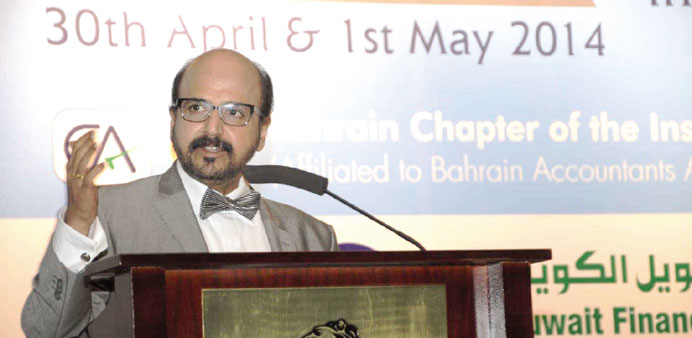
Seetharaman: Women in 2020 will be financial decision makers.
Doha Bank group chief executive officer Dr R Seetharaman delivered a presentation on changing trends in global economy at a regional conference hosted by Bahrain’s Ministry of Finance.
At the conference, entitled “Financial Professionals - Partners in Nation Building,” Seetharaman spoke before regional bankers and finance professionals from various industries on the “Future of Banking in 2020.”
Seetharaman highlighted the emerging trends in banking industry by explaining that “the old attitude, which cantered on traditional banking services, proprietary products, and less differentiation is shifting towards a new attitude in which we analyse needs and differentiate, collaborate, and diversify.”
Providing insights into the impact of digital banking, Seetharaman said “The mobile device will be the world’s primary connection tool to the Internet in 2020. According to Mc-Kinsey, the number of digital banking consumers in Asia would reach 1.7bn by 2020, with China, India, and Asean seeing the biggest gains.”
“The local GCC (Gulf Co-operation Council) banks are well-positioned to build on a solid online banking trend. In the next five years, GCC region online services are expected to triple and online sales to new customers to increase fivefold. This will enable banks to emphasise on small outlets rather than full-fledged branches,” he stressed.
He also highlighted on retail and wealth management in 2020 and said “Fiscal problems will reduce social support services from federal, state, and local governments. Individuals will become responsible and accountable for most risk-related decisions in the areas of financial planning, retirement, insurance and healthcare.”
“Women in 2020 will be financial decision makers as businesswomen and consumers. According to PwC, the rise in the volume of investable assets is set to increase to $102tn by 2020,” Seetharaman said.
“The US economy is recovering and the euro area and the UK indicate signs of recovery. There is slower growth in emerging economies however, they still contribute to global growth,” Seetharaman said. “There is increasing global attention in developing Asian regions. There are growing voices from emerging economies and their demand for more equitable positions.”
According to Seetharaman, removing “bottlenecks of global trade liberalisation” and enabling all countries to participate in the global economy is the “biggest challenge” for all countries.
“The use of the yuan has been increasing with China having a programme to internationalise its currency by allowing the yuan to be used to settle cross-border trade. There are evolving partnerships amongst countries to cope up with global competitiveness and threats,” he stressed.
Seetharaman also provided insights into changing trends impacting the financial services industry. He said “The regulatory realignment is happening in the financial services industry. The costs of regulation and competitive pressures will lead to industry consolidation.
“The need to improve scale advantages, spread increasing regulatory costs over a larger base of business, and lower costs by improving efficiencies will result in more mergers, acquisitions, and industry consolidation,” he said.
Seetharaman emphasised that through partnerships and collaboration, smaller and mid-sized players will provide the breadth and depth of services customers require at an affordable cost.
Non-traditional competitors will occupy a significant space in the financial services industry. Some of the non-traditional players in financial services industry include Walmart, Virgin Money, Deutsche Postbank AG, and UK Post Office, he noted.