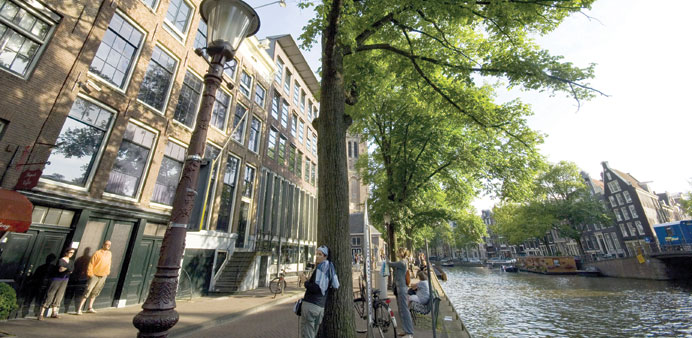
The Prinsengracht in central Amsterdam. Anne Frank hid from the Nazis in a backyard house here.
By Lea Sibbel
The mechanical arm plunges into the murky water of the Herengracht canal, observed by a gaggle of tourists craning their necks from a nearby bridge to gain a good view.
The claw-like tentacle brings up bicycle after bicycle, dumping them onto an ever growing rusty pile amid ships.
The garbage boat has the task of cleansing Amsterdam’s canals of the countless bulky objects which people have hurled into them. Quite why the city’s waterways have become a cycle graveyard is unclear.
Amsterdam’s city fathers certainly had something completely different in mind when they designed the street and canal layout on a drawing board 400 years ago.
At the end of the 16th century life was getting a little crowded in Amsterdam. Immigrants from distant parts of the world found it hard to find a place to live within the confines of the original city which was located around where the central station now stands.
“The immigrants arrived with money in their pockets and skills. That provided the city with a good deal of potential,” said Wite Lohman, manager of the Grachtenhuis Museum which tells the story of the world-famous canals.
In order to give the new city dwellers more elbow-room it was decided to expand.
The Grachtenhuis contains an impressive light installation which brings vividly to life what happened back then. The mayor, treasurer, engineers, architects and last but not least, representatives of the military, put their heads together to work out how the city should grow.
Extensive plans were drawn up and cast aside before new ones replaced them. All those involved were driven by the need to create more space and a handsome new city yet there was disagreement in their ranks.
The military insisted on defensive walls and in the end a compromise was reached. Four new canals were dug in concentric circles around the old city centre. Their names were chosen as Singel, Herengracht, Keizersgracht and Prinsengracht.
A good deal of sand was needed in order to carry out the work since Amsterdam lies below sea level. Sand alone however was not enough to achieve the ambitious plans of the architects. Each house was built on a scaffolding of wooden piles to prevent the buildings from sinking further into the mire below.
The piles underneath explain how the houses along the canals came into being and also why they are never more than four or five storeys high. The sheer weight of taller houses would have steadily pressed the piles further into the ground — in effect the houses would have become their own undoing.
Some aspects of the construction are puzzling to this day, said Lohmann: “Nobody is quite sure how the workers pulled off this feat. For instance how did they stop the groundwater seeping back into a canal while it was being dug out.”
A large number of workers had to be recruited for the expansion project.
“A lot of Germans came here to build the canals,” said Marc Paping. The Dutchman, who introduces himself simply as “Paap” offers private boat tours of the canals. He eschews colourful posters advertising the tours and customers hear of his services by word of mouth.
Travelling west of the central station in a southerly direction Paap’s vessel chugs past the Anne Frank House on Prinsengracht and up to the Leidsegracht, the small canal in the central belt which joins up the other canals.
“This marks the end of the first phase of construction,” explains Paap. The second phase was quickly completed in an arc to the river Amsel, the city’s broad natural waterway.
“By the time they got to phase three they realised they had built too much and promptly leased off the land for agricultural usage.” The district is known as “Plantage” (Plantation) to this day.
The idea of a city having too much space for residential development seems odd today, especially to anyone who has tried to find a place to live. Apartments in Amsterdam are highly sought-after and ones with a view of the canals all the more so.
“A total of around 40% of Amsterdam folk can see a canal from their flat or house,” said Paap. He ought to know since he lives in a houseboat with a prime view.
Houseboats are an integral part of the Amsterdam cityscape just like the “Hageslag” chocolate granules sprinkled on Dutch breakfast toast.
The floating homes have been brought up to 21st century standard, with mains electricity. A final few are currently being linked up with the city sewers. For centuries the canals served as the drains.
Tourist officials hope that the rejuvenated canal system will pull in the tourists this year alongside the relaunch of another major attraction.
The celebrated Rijksmuseum re-opens its doors this year after extensive renovation. The Concertgebouw concert hall is also marking its 125th anniversary. Nevertheless, the canals take pride of place this year. “2 Magical Winters” is the name given by artists to the illuminations, which are designed to bathe the canals in fascinating patterns of light. — DPA