


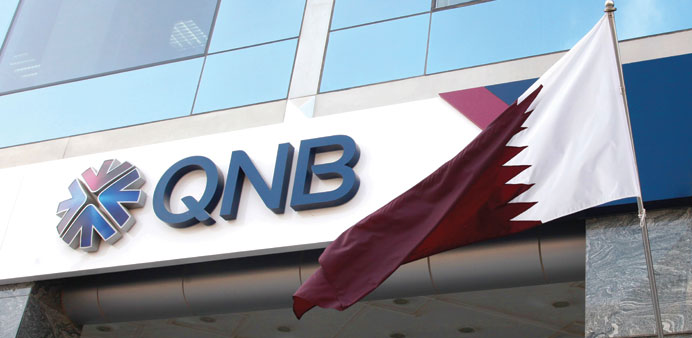
A Qatar national flag flies outside a branch of QNB in Doha. The biggest bank in the Gulf region is targeting 31% of its profits and 26% of its lending to come from its international operations in 2014, up from 28% and 19% respectively last year. The bank hopes to have 40% of profits from foreign sources by 2017, according to its chief financial officer Ramzi Mari.
Reuters/Doha
QNB is aiming to become the largest lender in the Middle East and Africa, its finance head said yesterday, as the bank continues to look beyond its home market for growth opportunities.
Currently the biggest bank in the Gulf region, it is looking for acquisition targets in Turkey, Morocco and sub-Saharan Africa, chief financial officer Ramzi Mari told Reuters in an interview at the bank’s Doha headquarters.
“Our goal is to be the largest financial institution in the Middle East and Africa by 2017. So this makes us interested in some of the markets that we don’t have a presence in,” he said.
South Africa’s Standard Bank is Africa’s largest bank with assets worth $154.4bn as of June 30, 2013.
QNB’s assets at the end of 2013 stood at $121.8bn and the lender, which bought Societe Generale’s Egyptian business last year for $2bn, is not currently working on any acquisitions, Mari said.
Opportunities were fewer than in recent years, Mari said, as European banks like Societe Generale, who had sold assets to shore up their capital bases, were now in a stronger position. Meanwhile, valuations in the Middle East and Africa, which had been depressed by the Arab Spring, were also not as low.
“The pressure now is less to offload their jewel assets,” Mari said. “We want a controlling stake and the opportunities are limited. Investment banks come and throw offers on your desk and often the offer does not meet QNB criteria.”
QNB has benefited in recent years from substantial economic growth in the Gulf Arab nation, driven by Qatar’s huge hydrocarbon wealth, while infrastructure development and work towards hosting the 2022 soccer World Cup are expected to be key earnings drivers for all Qatari lenders going forward.
However, GDP growth is falling from the double-digits seen previously, although still buoyant at around 6% in 2013, and competition within the banking sector - there are 18 lenders in a country of just over 2mn people - is forcing banks to seek foreign revenue streams to compensate for tighter domestic conditions.
QNB is targeting 31% of its profits and 26% of its lending to come from its international operations in 2014, Mari said, up from 28% and 19% respectively last year. The bank hopes to have 40% of profits from foreign sources by 2017, he added.
The bank, 50% owned by sovereign wealth fund the Qatar Investment Authority, is targeting a net profit gain of between 7% and 9% and loan growth of between 12% and 14% in 2014, with international markets becoming increasingly important in fuelling higher lending, said Mari.
In 2013 the bank’s net profit rose 13.7%, with lending growth up 24.3%.
Despite the continuing economic and political problems faced by Egypt, Mari said he was confident that QNB’s Egyptian business would be a strong earnings driver in the coming year having seen profit rise 17% in 2013.
Mari said he was currently working on a new five-year strategy for the Egyptian business which would include expanding the branch network.