


Dollar
The dollar lost ground against all of its major competitors on Friday, following its recent gains. Positive economic data, like the better than expected retail sales and jobless claims data, drove the currency higher earlier this week. However, consumer sentiment fell sharply at the end of the trading week, while consumer prices climbed more than expected.
Consumer prices in the US rose by more than expected in the month of February, according to a report released by the Labor Department on Friday, with the monthly price growth largely due to a sharp jump in energy prices.
The Labor Department said its consumer price index rose by 0.7% in February after coming in essentially unchanged in each of the two previous months. Economists had been expecting consumer prices to increase by about 0.5%.
While the Federal Reserve Bank of New York released a report on Friday showing that conditions for New York manufacturers continued to improve in March, the pace of improvement unexpectedly showed a modest slowdown compared to the previous month.
The New York Fed said its general business conditions index edged down to 9.2 in March from 10.0 in February, although a positive reading indicates an increase in regional manufacturing activity. Economists had expected the index to come in unchanged.
Industrial production in the US increased by more than economists had been expecting in February, according to a report released by the Fed on Friday. It said industrial production rose by 0.7% in February after coming in unchanged in January. Economists had expected production to increase by 0.5%.
Consumer sentiment in the US has seen a notable deterioration in the month of March, according to a report released by Thomson Reuters and the University of Michigan on Friday, with the consumer sentiment index falling to its lowest level in over a year.
The report showed that the preliminary reading on the consumer sentiment index for March came in at 71.8 compared to February’s final reading of 77.6. The sharp drop came as a surprise to economists, who had been expecting the consumer sentiment index to edge up to a reading of 78.0.
The Fed on Thursday approved capital plans of 14 leading US banks as part of its Comprehensive Capital Analysis and Review - the so-called annual stress tests that gauge the capital adequacy of banks and the impact of buybacks and dividends on their finances.
Euro
European Union leaders on late-Thursday called for strong measures to address the issues of worsening economic and labour market situation at the EU summit in Brussels, while thousands staged anti-austerity protests at the Belgian capital.
The leaders closely analysed the region’s efforts to balance austerity, growth and employment. There were more calls for pro-growth policies, especially from France and Italy.
At the summit, there was an unusual urgency among leaders to address the unemployment problem, particularly among youth, as they feared it could lead to serious social unrest.
German Chancellor Angela Merkel, though stuck to her stance of continued austerity, stressed on the need to fight unemployment. “We will have one priority: the fight against youth unemployment,” Merkel said ahead of the meeting. “We have to get the money to the people so that young people get jobs.”
Portugal’s creditors have relaxed the fiscal deficit targets set under a bailout programme, and allowed more time for the government to implement the controversial austerity measures, after outlook for the troubled economy worsened, a report from the International Monetary Fund said on Friday.
The group of creditors, comprising the European Commission, the European Central Bank and the IMF, revised the budget deficit target for this year to 5.5% of GDP from the previous target of 4.5%. The goal for 2014 has been raised to 4% from 2.5%. At 2.5%, the target for 2015 is below the 3% threshold set under the bailout norms.
Finance Minister Vitor Gaspar, while addressing a press conference, said that the latest review by the troika has made Portugal eligible to receive the next tranche of rescue loans valued €2bn.
The dollar rose to a 3-month high of $1.2910 against the euro on Thursday, but has dropped to a 1-week low of $1.3106 on Friday.
Inflation in euro area slowed to 1.8% in February from 2% in January, matching preliminary estimates, data from Eurostat showed on Friday. This was the lowest rate of inflation since August 2010. A year earlier the rate was 2.7%. Monthly inflation was 0.4% in February.
Hourly labour costs in the euro area increased 1.3% year-on-year in the fourth quarter, down from the 1.8% rise logged a quarter ago, Eurostat reported on Friday.
The two components of labour costs, namely wages and salaries and non-wage costs grew at slower rates in the fourth quarter. Wages and salaries per hour worked grew by 1.4%, slower than the 2% rise seen in the third quarter. The non-wage component climbed 1%, following a 1.4% growth.
Spain’s public debt hit a record level at the end of 2012 due to higher requirements for funds both at federal and autonomous levels. Public debt reached 84.1% of gross domestic product in 2012 compared to 69.3% a year earlier. This is well above the European Union’s ceiling of 60%.
Range for previous week: $1.2910–$1.3105
Range for this week: $1.2895–$1.3195
Sterling
The greenback has extended Thursday’s weakness against the pound sterling on Friday, falling to a week and a half low of $1.5175. The US currency has since bounced back to around $1.5120.
Confidence among British households regarding their property prices improved in March, ending thirty-two months of negative sentiment, data from a survey by Markit Economics and Knight Frank showed on Friday. The house price sentiment index increased to 50 in March from 48.4 in February.
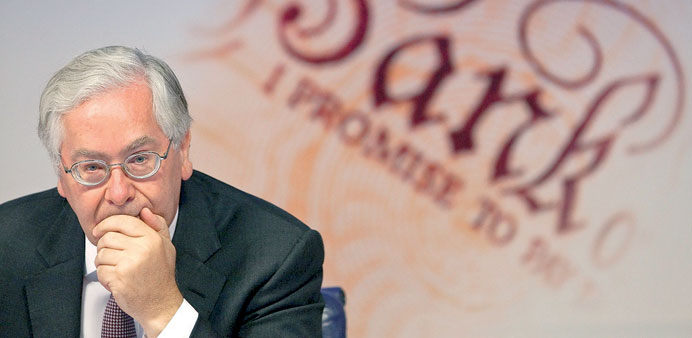
Bank of England chief Mervyn King suggested this week the “black cloud” over the economy may be lifting, but with assets buoyant and the pound feeble, what investors think of Britain’s growth prospects is less clear. King surprised markets by saying on Thursday he saw “momentum” behind a UK recovery that will emerge this year, and that sterling was fairly valued after a recent tumble.
Sterling remains about 25% lower on a trade-weighted basis than before the crisis that started in 2007, however, while soaring British stock prices appear in step with King’s new-found optimism.
But which more accurately reflects investors’ views of the British economy after a long period during which financial sector retrenchment; household deleveraging and fiscal austerity have meant little or no growth? But for overseas investors, who according to the Office for National Statistics own more than 40% of Britain’s stock market, the key issue may be the performance of sterling. A dollar-based fund invested in the FTSE 100, which has gained 10% in 2013, would have seen its gains reduced to just 3% once the falling pound is taken into account.
With 10-year gilts offering annual yields of less than 2%, a sustained exchange rate move like the one we’ve seen this year is also a potential wipe-out for bond investors. And as few expect any let-up in government’s fiscal squeeze in next week’s annual budget, the pound will ultimately take its cue from whether the central bank moves again to support the economy by printing more money to buy bonds.
BoE minutes next week will reveal whether King still favours more bond-buying and if he’s winning the debate among fellow monetary policymakers. Beyond that, new governor Mark Carney is widely expected to be given a more dovish mandate when he takes over from King in July.
Range for previous week: $1.4829–$1.5176
Range for this week: $1.4925–$1.5260
Yen
International toleration of a weak yen may rise, opening the way for it to fall towards 100 to the dollar, after Japan decided on Friday to seek to join talks on a US-led Pacific free trade pact. US President Barack Obama would hope to include Japan, the world’s third largest economy, in the Trans-Pacific Partnership (TPP), a projected free trade bloc that currently would not include China. That would have geopolitical as well as economic advantages for Washington, binding Japan into a broader US-led Pacific Rim bloc.
An implicit quid pro quo might be that yen weakness - the dollar is up 15.7% against the Japanese currency since October on expectations of looser Bank of Japan monetary policy - would not encounter strong objections.
It might also make a weakening of the yen to 100 against the dollar more palatable to Washington, if successful negotiations lastingly opened up Japanese markets to more US products.
But Japanese Prime Minister Shinzo Abe’s decision, even with his current 70% approval rating, is not without risks. While TPP membership would arguably increase Japan’s ability to tap into the wider economic growth around the Pacific basin, it would also open Japan up to tough competition.
TPP talks envisage phasing out tariffs for agricultural products, a move that will not play well with Japanese farmers, a bulwark of support for Abe’s Liberal Democratic Party.
Japan will also have noted that while “all goods are on the table”, according to TPP US negotiator Barbara Weisel, some US lawmakers are already exhibiting qualms.
Four dozen Democratic lawmakers wrote to Obama this week to express concern about Japan joining the free trade talks. They urged Obama to maintain US tariffs on Japanese autos and trucks if Tokyo does enter the negotiations.
That does not sound like unfettered free trade, although the trade off might yet be that Japan retains its protection of its farmers in exchange for the US keeping auto and truck tariffs in place.
Nevertheless, with Abe having decided to engage in the talks against this backdrop, perhaps the least he might expect is Washington’s forbearance about the slide in the yen.
Range for previous week: ¥95.06–¥96.71
Range for this week: ¥95.50–¥96.15