


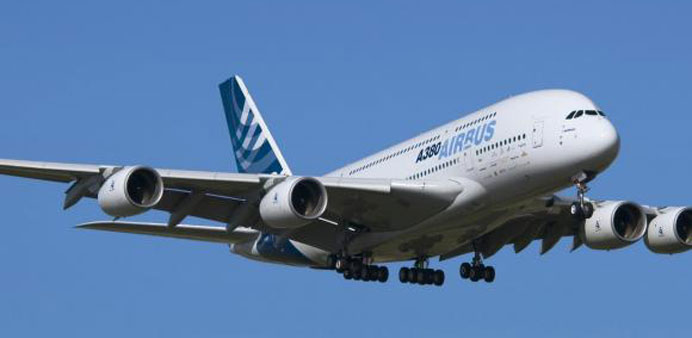
Airbus parent Eads formally buried its failed $45bn merger with defence contractor BAE Systems and cheered investors with evidence that civil aviation growth continues unabated.
Shares in Europe’s largest aerospace company hit a record high yesterday after it unveiled higher than expected 2012 earnings and raised its dividend despite charges at its defence and helicopter operations.
Chief Executive Tom Enders said he was “comfortable” with defence providing only 20-25% of overall group revenue, rather than the long-targeted equal split that would have resulted from a deal with Britain’s BAE.
Investors had largely opposed the deal because it would have diluted their exposure to strong demand from airlines in emerging markets — a rare bright spot in an otherwise bleak climate for industrial goods made in Western economies.
Strategy chief Marwan Lahoud told Reuters that the BAE deal was now “off the table”, dismissing lingering speculation that Eads was still clinging to hopes of reviving the deal.
Eads, which makes drones, fighter jets and missiles, will study defence activities and potentially stop some of them if they fail to meet the group’s criteria, he said in an interview.
While defence spending has been hit hard by budget cuts, passenger jet production has largely ridden out the economic crisis thanks to airline growth in emerging markets.
Eads operating profit rose 68% to €3bn ($3.92bn) in 2012 for an operating margin of 5.3% on revenue up 15% to €56.5bn.
Net profit grew 19% to €1.2bn.
For 2013 it targeted €3.5bn in operating profit and earnings per share of €2.5, up from €2.24, before a planned share buyback linked to a shake-up of shareholdings.
The company said that it had largely absorbed the costs of repairing and preventing cracks on the A380, the world’s largest airliner. Any further potential one-off costs should be limited mainly to its next big project, the A350, which it continued to describe as “challenging”.
For now, it is sticking to plans to fly the A350 this summer. Europe’s rival to Boeing’s carbon-composite 787 was rolled off the assembly line in France on Tuesday for ground tests.
Eads is targeting an operating margin of 10% in 2015, broadly on a par with Boeing, which has long outstripped Airbus in profitability — blurred by accounting differences that allow it to defer the impact of heavy 787 development spending.
Analysts had forecast Eads revenues of €54.88bn and net income of 1.475bn, according to consensus data.
A traditional end-of-year slew of cash from European government customers, which tend to pay in the fourth quarter, reversed an unexpected hole in Eads cashflow in the third quarter, with annual free cashflow before acquisitions at €1.4bn. Eads aims for underlying cashflow breakeven in 2013.
Bouygues
Bouygues reported a 41% drop in full-year profits yesterday as cut-throat competition hit the French conglomerate’s telecom business, which is cutting costs to try to deliver a turnaround this year.
Telecoms is the third-biggest revenue driver for Bouygues after construction and roadworks, but the business is battling a price war in the French mobile market.
Bouygues forecast stable group revenues this year and also said margins should improve with the help of savings of 300mn euros ($392mn) at its mobile business on top of 151mn last year.
In the fourth quarter, Bouygues Telecom said it was able to stem the loss of customers to cheaper rivals by adding 285,000 new mobile contract customers as well as 453,000 new customers for its low-cost service B&YOU.
Bouygues full-year net profit dropped to €633mn, down 437mn on 2011. Bouygues Telecom accounted for 345mn euros of the drop.
The company forecast that core profit at its telecom business would stabilise this year, although sales are expected to fall 7%.
Bouygues is aiming to for flat sales overall in 2013, with the expected decline at Bouygues Telecom offset by improving business at its residential construction unit.
Sales rose 3% last year to €33.5bn, compared with a Thomson Reuters I/B/E/S analyst poll average of €33.3bn.
The construction unit reported that sales rose 9% in 2012 after it secured large infrastructure contracts in Hong Kong and Thailand.
Its order book at the end of December was 12% higher than a year earlier at €17.1bn.
Bouygues is paying an unchanged dividend of €1.6 a share for last year.
Centrica
Centrica posted a 9% rise in profit at its British Gas business, the country’s biggest household energy supplier, putting pressure on it to justify an inflation-beating rise in prices in the midst of a recession.
Centrica, which reported a 5% increase in group earnings for last year, said yesterday the price rises were needed to cover energy costs, investment and to secure supplies.
“We recognise that it is very difficult,” Chief Executive Sam Laidlaw told the BBC’s Today radio programme when grilled about a 6% rise in prices for consumers.
But he said the firm had entered into £50bn ($76bn) worth of commitments to secure supplies and “you cannot do that unless you remain a successful company.”
Centrica said British Gas’s profits rose 9% to £1.09bn, just above analysts’ average forecast of 1.07bn and helped by an 11% increase at the unit’s residential energy supply business.
Cold weather pushed up gas consumption by 12%.
Centrica said profits rose across all four of its business units, with the biggest contributor to the rise from its production arm where profits increased 20% following investments in both Britain and Norway last year.
In a strategy update, the company said it aimed to double profitability at its North American processing and storage business over the next 3-5 years as well as increase international gas production.
Luff added investment in shale gas in Britain was not off the table.
Centrica reported earnings per share (EPS) for the year ended December up 5% to 27.1 pence, in line with forecasts. Adjusted operating profit rose 14% to 2.74bn pounds, ahead of analysts’ expectations of 2.61bn.
AB InBev
Anheuser-Busch InBev, the world’s biggest brewer, forecast a pick up in sales in Brazil and easing cost pressures in the US would help it bounce back from a slow start to the year in its two largest markets.
The maker of Budweiser and Stella Artois makes about 80% of revenue in the Americas, shielding it from recession-hit Europe but still giving it a mix of trading conditions with fast-growing emerging markets and a more mature US business.
Underscoring its confidence, AB InBev raised its 2012 dividend by a larger-than-expected 50¢ to €1.7 ($2.22) a share, despite plans to pay $20.1bn for the 50% of Mexico’s Grupo Modelo it does not already own.
Analysts had expected a dividend of €1.48, according to the Thomson Reuters Starmine SmartEstimate, which weights analysts according to their past record.
The company met forecasts with fourth-quarter earnings before interest, tax, depreciation and amortisation (EBITDA) of $4.39bn, up 9.9% on a like-for-like basis.
At 1250 GMT, AB InBev shares were up 1.1%, against a flat STOXX Europe 600 food and beverage index.
AB InBev also said it expected US profit margins to rise this year, following a contraction in 2012, thanks to easing pressures from costs and investments.
It forecast costs per hectolitre to rise by a mid-single-digit percentage, against a 7.2% increase in 2012.
Distribution costs would also increase by a mid-single-digit percentage, less than the 8.9% last year caused partly by higher fuel prices and because of the rollout of Bud Light Lime-a-Rita, which was made in only one US plant and so had to be transported further.
That should be three plants by the end of 2013.
Petrofac
British oil services firm Petrofac just missed 2012 profit forecasts and failed to give a specific target for this year, spooking investors already unnerved by a rivals’ shock profit warning.
Shares in Petrofac dropped as much as 5% in early yesterday trading to their lowest level in over three months, recording the biggest fall on Britain’s blue-chip index.
The company, which designs and builds oil and gas infrastructure and also invests alongside oil firms in oil fields, said a strong pipeline of bidding opportunities meant it would deliver “good growth” in net profit this year, giving it confidence in a 2015 earnings target.
This time last year, Petrofac said it expected profit to grow by at least 15% in 2012.
Petrofac posted a 17% rise in net profit to $632mn for last year, just below a $636mn company-supplied consensus forecast. The company said it continued to see a strong pipeline of bidding opportunities in its key markets in the Middle East, Africa and the former Soviet Union, giving it confidence in a target to double its recurring 2010 group earnings by 2015.
It also announced a plan to spend $1bn over the next five years to develop an offshore part of the business that can build projects in deep water. Its current capability is focused on engineering big projects onshore in places like Turkmenistan, Algeria and Iraq.
“There is little in these results to trigger any meaningful near-term share price upside, and we expect a negative reaction to the $1bn offshore investment announced,” JP Morgan analysts said.
United Overseas Bank
Singapore’s United Overseas Bank (UOB) reported a 25% jump in fourth-quarter net profit, lifted by strong fee and commission income.
UOB, the smallest of Singapore’s three banking groups, posted net profit of S$696mn ($561.5mn) for the three months ended in December, up from S$558mn a year earlier. But the net interest margin fell for the third consecutive quarter.
“This set of results represents a very positive end to 2012. We achieved record profits, record fees and record contribution from our key regional markets,” UOB’s chief executive officer Wee Ee Cheong said in a statement yesterday.
This month, Singapore’s Oversea-Chinese Banking Corp reported a 12% jump in fourth-quarter net profit to S$663mn. DBS Group Holdings, Southeast Asia’s biggest bank, posted weaker-than-expected results due to weak interest margins.
Esprit
Esprit yesterday announced a net loss of HK$465mn ($60mn) for the six months ending December as the fashion retailer continues a four-year transformation drive.
The Hong Kong-listed company posted a net profit of HK$555mn in the same period a year earlier.
Revenue fell to HK$13.6bn in the six months ending December from HK$16.7bn the previous year, it said.
Esprit raised $667mn in November by selling 646.1mn shares in an effort to fund its multibillion-dollar transformation plan.
The company, which was founded in San Francisco in 1968 and is headquartered in Hong Kong, announced its exit from Spain, Denmark and Sweden to focus on Asia as part of the transformation after it saw a 98% plunge in net profit in 2011.
While about 80% of Esprit’s revenue is from Europe, the Asia-Pacific region - and specifically China — is important to its turnaround plan.
Gutierrez, a former senior executive at Spanish clothing retailer Zara, was appointed chief executive last August after former CEO Ronald Van der Vis resigned.
AIA
Asian insurance giant AIA said yeterday its net profit for the year rocketed almost 90%, building on growth from previous years despite a challenging economic environment.
Hong Kong-listed AIA said net profit for the year ended November 30 jumped to $3.02bn from $1.60bn the previous year. New business, a key performance measure for profitability, grew by 27% to $1.19bn, up from $932mn.
The company was formerly owned by US insurer American International Group (AIG), which was bailed out by Washington during the financial crisis and sold its remaining AIA shares last December, raising $6.45bn.
AIG sold two-thirds of the unit in a Hong Kong listing in 2010 to help repay the financial aid.
AIA in October bought Dutch banking firm ING’s Malaysian insurance unit and in December took over Sri Lankan insurer Aviva NDB Insurance. The firm, which operates in 14 Asia-Pacific markets, raised $20.5bn in an initial public offering in 2010.
Amadeus
Spanish travel technology company Amadeus IT Holding said yesterday it was “cautiously optimistic” after reporting solid full-year results for 2012.
Earnings and revenues rose in line with analyst expectations at the Madrid-based firm, which is shielded from Spain’s economic crisis thanks to its geographic diversity and buoyed by a resilient travel market in the global slowdown.
Amadeus reported a 7.5% rise in full-year revenues to €2.91bn ($3.79bn) for 2012 yesterday, in line with consensus estimates. The company said it would pay out a dividend of €0.50 per share, a 35% increase year-on-year.
The firm said the number of airline passengers that booked through its Altea system grew 28% year-on-year to 563.8mn people.
Amadeus said earnings before interest, taxes, depreciation and amortisation (EBITDA) increased 6.6% to 1.1bn euros, while adjusted profit grew 18% to 575mn euros.
The technology company, which recently announced that Sri Lankan Airlines had signed up to use its Altea booking system, said the platform attracted 10 new clients in 2012.
Fortress
Fortress Investment Groups’ profit rose significantly in the fourth quarter as many of its funds recorded gains that helped to boost incentive income as well as management fees.
New York-based Fortress, one of a handful of publicly traded alternative asset managers, said yesterday that pretax distributable earnings rose 114% to $107mn, or 20 cents per share, from $50mn, or 9¢ per share, a year earlier.
For the full year, pretax distributable earnings rose roughly 15% to $278mn, from $242mn in 2011.
Fortress said pretax distributable income is the best way to measure its performance because it excludes large quarterly compensation costs stemming from the equity interest of principals who took the company public in 2007.
The firm announced a fourth-quarter dividend of 6¢ per share.
The firm said management fees were $131mn in the fourth quarter of 2012, up from $121mn for the fourth quarter of 2011.
The firm’s assets under management increased 4% from the previous quarter to $53.4bn as of December 31, 2012.