


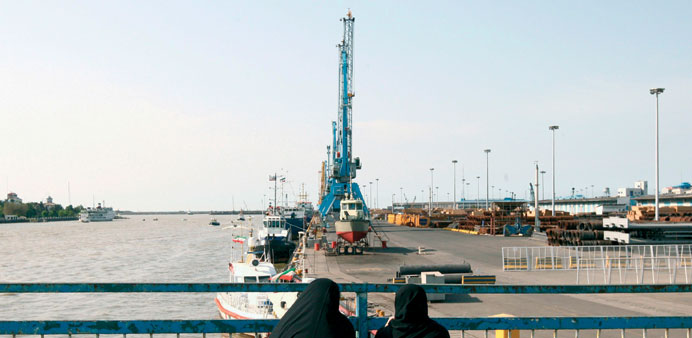
File picture made available on 27 April 2012 shows Iranian women looking at the Anzali port in the city of Anzali in the Caspian Sea province of Gilan, northern Iran. The national currency has weakened over the last year, reaching 38,900 rials to the US dollar compared with 16,900 in January 2012.
Bloomberg/Dubai/Mumbai
Iran faces a fresh obstacle to turning its most lucrative export into cash as the US tightens sanctions to keep importers from paying for the oil with dollars and euros.
Under penalty of expulsion from the US banking system, Iranian crude customers such as China, Japan and India will be restricted to using their own currencies for the purchases, starting Wednesday. Importers will be compelled to keep the payments in escrow accounts that Iran can use only for locally sourced goods and services, in what will amount to barter arrangements.
“They’ll have to accept that a lot of cash is piling up in banks in importing countries, and they’ll now have to look for ways to get it out,” said Robin Mills, the head of consulting at Dubai-based Manaar Energy Consulting & Project Management, in a January 31 phone interview. “It’s making the trade much more difficult.”
Crude production and exports from Iran plunged in the past year as the US and European Union sought to choke off money to Iran to dissuade it from pursuing a nuclear programme. The sanctions, part of US legislation passed last year, may exacerbate the decline because it forces bartering with countries whose exports to Iran are in almost every case less than the amount of oil they buy from it.
Iran exported 1.2mn bpd a day in December, with China, South Korea, Japan and India accounting for 84%, the International Energy Agency said in a January 18 report. Sales were less than half of what Iran shipped on average during the first 10 months of 2011, IEA data show.
Sanctions enacted previously sought to isolate Iran’s banks and the scarcity of foreign exchange flowing into the economy has led to skyrocketing prices for consumer goods such as meat. The national currency has weakened over the last year, reaching 38,900 rials to the US dollar compared with 16,900 in January 2012.
The new blockage on remittances will add to financial restrictions the US imposed last year that curtail Iran’s access to dollars, euros and other hard currencies. Sanctions have already forced it into barter arrangements with China, its largest oil customer, Mahmoud Bahmani, Iran’s central bank governor, said a year ago.
Increased bartering is one way to counter the additional US measures, Yahya Ale-Eshagh, head of the Tehran Chamber of Commerce, Industries and Mines, said on Tuesday.
“It’s time for private companies to act and take responsibility for actions the government is unable to carry out,” Ale-Eshagh told chamber members, according to the state-run Fars news agency. “A war is waged against Iran, so we should use all our potential, accept the costs and open the way for private companies.”
South Korean buyers have been paying for Iranian crude in local won, through two accounts that Iran’s central bank opened in 2010 at the Industrial Bank of Korea and Woori Bank.
Iran has made “precise” plans for increased imports of goods through barter, including the formation of a special committee to handle such trade, Fars reported on Tuesday, citing Deputy Commerce Minister Hamid Safdel. Iran previously sought to trade oil for wheat from Pakistan and Russia, media reports from the countries said.
“It’s getting more and more complicated every month,” Samuel Ciszuk, a consultant at KBC Energy Economics in Walton-on-Thames near London, said by telephone on January 31. The new US measures “will further cement the fact that Iran has to rely on a very small group of countries” for sales, he said.
China cut 2012 crude imports from the country by 21% to 22mn tonnes, customs data show. China’s total exports to Iran were $11.6bn last year, compared with Chinese purchases from the country that declined 18% to $24.9bn, the data show.
Japan’s imports from Iran fell 38%, to $6.9bn, last year, according to data from the Ministry of Finance. Its exports of mainly chemical and rubber products plunged 62% to $561mn, the data showed.
“Iran will probably have to continue oil exports to Japan and other countries because there is no other way,” Osamu Fujisawa, an independent oil economist who worked for Saudi Arabian Oil Co and Royal Dutch Shell, said on Tuesday from Tokyo. “This is not happy news for Iran.”
Inflation in the country accelerated to about 29% last month, up from 22% in May, according to the central bank. The International Monetary Fund predicts Iran’s economy will expand at a 0.8% rate this year compared with a 0.9% contraction in 2012.
South Korea’s exports to Iran of goods such as iron and steel products and petrochemicals increased 3.2% to $6.3bn last year, while imports dropped 25%, to $8.5bn, according to customs data. Oil made up 99% of the goods that Japan and South Korea imported from Iran.
India bought about $13.6bn worth of products like oil, urea, and anhydrous ammonia from Iran in the year through March 2012, while Iran’s purchases of Indian goods like rice, sugar and soy bean oil extracts were worth about $2.4bn.
Iran, formerly the second-biggest producer in the 12-member Organisation of Petroleum Exporting Countries, has slipped to a fifth-place tie with the UAE, according to data compiled by Bloomberg. It pumped 2.6mn bpd a day last month, the data show.
Shipments dipped below 1mn bpd in July after the EU banned purchases of Iranian crude, and rebounded to as much as 1.45mn bpd in November as other buyers replaced the hole left by European refiners, according to the IEA, a Paris-based adviser to 28 industrialised nations.
The IEA said in December that Iran’s exports will probably decline to about 1mn bpd in January and remain near that level for months. Iran itself expects to export an estimated 1.5mn bpd in the Iranian year starting March 21, Gholamreza Kateb, a spokesman for the parliamentary planning and budget committee, said in comments reported by the state-run Iranian Students News Agency on Thursday.
Iran’s net oil export revenue dropped to $64bn for the first 11 months of 2012, compared with $95bn for all of 2011, according an estimate by the US Energy Information Administration, an arm of the Energy Department.
Even so, the revenue Iran can generate from its current level of exports is probably enough to sustain its economy, said Olivier Jakob, managing director of consultants Petromatrix GmbH in Zug, Switzerland.
‘Iran banks bypass ban on electronic dealings’
Iran’s banks have been able to bypass a ban imposed last year on carrying out global financial transactions via the world’s most-used electronic payment system, known as SWIFT, according to officials at the Belgium-based company which runs the system.
They said that Iranian banks have been able to fall back on simpler methods for executing transactions with their international counterparts, sending instructions instead by telephone or email.
“It’s very clear that the Iranians have other means (of) moving their money around and commissioning transactions,” said Alain Raes, chief executive for EMEA and Asia Pacific at the Society for Worldwide Interbank Financial Telecommunication, or SWIFT.
The European firm was forced last March to disconnect around 30 Iranian banks, including the country’s central bank, from its network following a European Union ban on dealing with the institutions. Iran has faced progressively tougher sanctions from the US and the EU, in order to pressure the country to curb its nuclear programme. Iran denies it is planning to produce nuclear weapons.
SWIFT, which is supervised by the central banks of the G-10, as well as Belgium’s central bank, facilitates the flow of most electronic financial transactions. Almost all major banks and finance firms use it to send financial data and messages, making it akin to a globally-accepted postal service for financial transactions.
“Of course there are alternatives: you can send your payment instructions by email if you will, or can do it by telephone, though it is not as secure as SWIFT and lacks the convenience factor. But, yes, there are lots of alternatives to SWIFT,” said Gottfried Leibbrandt, the company’s chief executive. He and Raes spoke on the sidelines of a SWIFT press conference in Dubai.
Leibbrandt said there are still talks between his company and European regulators about whether it is appropriate for SWIFT to be required to impose sanctions on countries like Iran. “There is a dialogue going on around the trade-off between using us as a sanctions tool for other countries and impeding our role as really serving as a global infrastructure mechanism,” he said.
“We’ve seen reversals in Myanmar where banks were able to trade again. There is always a chance for a reversal if the reasons for the imposition of sanctions on affected banks are resolved,” Leibbrandt said.