


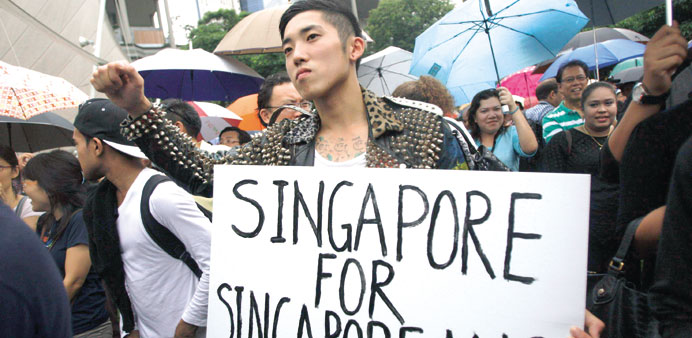
A man holds a sign at a demonstration against a government white paper on population at Speakers’ Corner in Singapore yesterday.
Reuters/Singapore
At least 4,000 people braved showers to stage one of Singapore’s largest ever protests yesterday, a further sign of discontent over immigration policies and growing income disparities under the long-ruling People’s Action Party (PAP).
Parliament in the highly regimented city state last week approved a white paper that said the island’s population of 5.3mn could grow by as much as 30% to 6.9mn by 2030, mostly through foreign workers to offset a chronically low birth rate.
Critics say the island is already too crowded, with a population density exceeding that of rival Asian business centre Hong Kong. They blame the flood of foreigners over the past decade for stagnant wages, crowded trains and rising prices that put housing beyond the reach of the average Singaporean and say further inflows would change the very nature of the island.
Uniformed police were all but absent at the rally at Speakers’ Corner in a park on the edge of Singapore’s glitzy financial district—exempt from strict controls on assembly.
“You cannot bring in foreigners to compete with your people when you do little to look after them,” said Leong Sze Hian, a financial planner, blaming lax immigration for stagnating real wages.
“It’s not just low wage earners who are suffering. Median incomes are affected too and that’s the people in the middle,” he told Reuters.
Tan Kin Lian, former CEO of Singapore’s largest insurance firm, told the rally that Singaporeans needed “adequate wages, dignity in employment for all sectors of the workforce. Wages must be enough to raise a family.” Singapore, with a land area of 714 square km, is one of the of the world’s wealthiest countries with a per capita GDP of $50,000.
It has been ruled since independence in 1965 by the PAP, credited with transforming the island from a British colonial outpost into a global business centre with clean streets, an efficient civil service and the world’s highest concentration of mnaires.
Income inequality is among the highest in the developed world, however, and many Singaporeans struggle on an average monthly wage of about S$4,100 ($3,300). The cost of housing has doubled over the past decade and the cheapest new car costs about S$110,000 due to taxes aimed at curbing vehicle ownership.
The PAP holds 80 of 87 elected seats in parliament despite recent electoral setbacks, including a dip in its share of the popular vote to about 60% in the 2011 general election.
As the rally proceeded, authorities said former prime minister Lee Kuan Yew, the driving force behind Singapore’s development and father of the current prime minister, was being treated in hospital for an irregular heart beat. It said Lee, 89, had recovered but would remain in hospital for a few days.
Authorities remain wary of social upheaval. A wildcat strike last year by bus drivers brought to Singapore from China, the first such work stoppage since 1986, led to the deportation of more than 20 of the strikers.
The government says without new immigrants, the working-age population will start shrinking in 2020 while the total number of Singaporeans will begin to decline in 2025.
The paper has prompted worries that further immigration could alter the character of the island.
Singaporeans acccount for 62% of 5.3 mn residents, down from 75% in 2000 and the government plans to give citizenship to between 15,000 and 25,000 foreigners each year. Based on the white paper, the percentage of Singaporeans, including new citizens, will shrink to 55% by 2030.
Tan Jee Say, a former top civil servant turned opposition politician who also addressed the protest, accused the PAP of being obsessed with economic growth and ignoring the social costs of its immigration policy.
“The white paper will completely change the character of our nation—not just for 18 years but forever,” he said.