


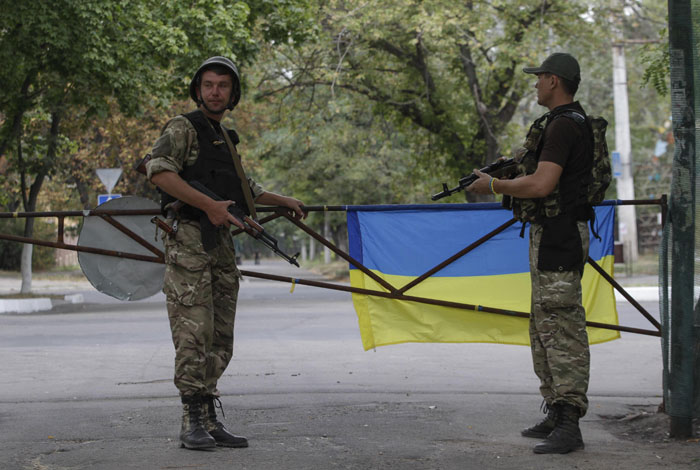
Soldiers stand guard at the base of Ukrainian self-defence battalion "Azov" in the southern coastal town of Mariupol on Sunday. A woman died and at least four people were wounded when fighting flared again in eastern Ukraine.
Reuters/Donetsk/Mariupol, Ukraine
A woman died and at least four people were wounded when fighting flared again in eastern Ukraine overnight into Sunday, jeopardising a ceasefire struck less than two days earlier between Ukrainian government forces and pro-Russian separatists.
The accord, brokered by envoys from Ukraine, the separatist leadership, Russia and Europe's OSCE security watchdog, is part of a peace plan intended to end a five-month conflict that has killed nearly 3,000 people and caused the sharpest confrontation between Russia and the West since the Cold War.
Shelling resumed near the port of Mariupol on the Sea of Azov late on Saturday night, just hours after Russian President Vladimir Putin and Ukrainian counterpart Petro Poroshenko had agreed in a phone call that the truce was holding.
Fighting also broke out early on Sunday on the northern outskirts of rebel-held Donetsk, the region's industrial hub. A Reuters reporter saw plumes of black smoke filling the sky near the airport, which has been in the hands of government forces.
"Listen to the sound of the ceasefire," joked one armed rebel. "There's a proper battle going on there."
The two cities then turned quiet for much of Sunday, but in the early evening a Reuters witness reported several mortar blasts within the city confines of Donetsk. They damaged a bridge where the rebels had erected a roadblock.
In a new report on the conflict, Amnesty International accused both the rebels and Ukrainian militia of war crimes and it published satellite images it said showed a build-up of Russian armour and artillery in eastern Ukraine.
"Our evidence shows that Russia is fuelling the conflict, both through direct interference and by supporting the separatists in the east. Russia must stop the steady flow of weapons and other support to an insurgent force heavily implicated in gross human rights violations," Amnesty's secretary-general, Salil Shetty, said in a statement.
Moscow denies dispatching forces or arming the rebels despite what NATO says is overwhelming evidence to the contrary.
Poroshenko spent Thursday and Friday at a NATO summit in Wales at which US President Barack Obama and other leaders urged Putin to pull forces out of Ukraine. NATO also approved wide-ranging plans to boost its defences in eastern Europe in response to the Ukraine crisis.
A senior aide to Poroshenko, Yuri Lytsenko, wrote on his Facebook page on Sunday that Kiev had reached agreement at the summit on receiving weapons and military advisers from five allies - the US, France, Italy, Poland and Norway.
He gave no further details, but four of the five countries denied offering such assistance.
"No US offer of lethal assistance has been made to Ukraine," a senior US official said on condition of anonymity.
Officials in Italy, Norway and Poland issued similar denials.
"Italy, along with other EU and NATO countries, is preparing a package of non-lethal military aid such as bullet-proof vests and helmets for Ukraine," an official at Italy's defence ministry said.
Both the rebels and the Ukrainian military insisted on Sunday they were strictly observing the ceasefire and blamed their opponents for any violations.
Earlier, government forces said they had come under artillery fire east of Mariupol, a crucial port for Ukrainian steel exports. In the days before the ceasefire they had been trying to repel a big rebel offensive against the city.
The shelling in Mariupol claimed the first civilian casualty since the ceasefire began. Local officials confirmed the death of a 33-year-old woman early on Sunday and said at least four other people had been wounded.