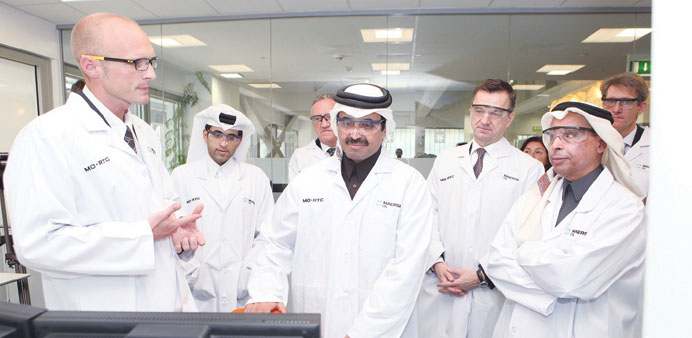
HE al-Sada and Thomasen along with senior QP and Maersk executives during the official opening of the new Digital Core Laboratory at the MO-RTC in Doha.
HE the Minister of Energy and Industry Dr Mohamed bin Saleh al-Sada officially opened the new Digital Core Laboratory at the Maersk Oil Research and Technology Centre (MO-RTC) in Doha.
During the ceremony, al-Sada also witnessed the signing of a “technology co-operation framework agreement” between Qatar Petroleum (QP) and Maersk Oil.
The agreement allows QP to use the Digital Core Laboratory for individual or joint research activities.
The laboratory - the first of its kind in the Middle East region - will support ongoing applied research efforts in the area of enhanced oil recovery, particularly in carbonate reservoirs such as Qatar’s Al Shaheen oil field, which is one of the most complex in the world.
The laboratory is part of a ten-year, $100mn investment by Maersk Oil in applied research in Qatar, focusing on enhanced oil recovery and the marine environment.
The minister congratulated Maersk Oil for bringing the laboratory to Qatar.
He said, “Qatar has made a commitment to be a leading centre for research and development, excellence, and innovation. Therefore, research facilities like this play an important role in fulfilling that goal. We are hopeful that the laboratory and the research findings that it will generate would greatly contribute to the future development of Qatar’s energy industry.”
Maersk Oil chief executive officer Jakob Thomasen said, “Working closely with our partner Qatar Petroleum, Maersk Oil has become specialists in understanding and applying the right technologies to maximise long-term production potential and unlock value from the complex Al Shaheen field. The Maersk Oil Digital Core Laboratory is a world-class facility that further strengthens our commitment to Qatar and applied research and technology development here in Qatar.”
By advancing understanding of the mineralogy of Al Shaheen reservoir rocks and of the subsurface chemistry and fluid flow relationship, the digital laboratory aims to improve enhanced oil recovery success rates.
Researchers at the laboratory use more than 13,000 X-ray images in a computed tomography (CT) scan to make a mathematical reconstruction of carbonate rock samples. The pores of oil-bearing rocks are studied at a minute level, down to a diameter of 40 times less than that of a human hair. When these data results are combined, a 3D image is produced that shows valuable petrophysical and flow-related information.
Abdulrahman al-Emadi, head, Maersk Oil’s Research and Technology Centre, said, “The collaboration agreement builds on Maersk Oil’s close relationship over the past 20 years with Qatar Petroleum, our partner at Al Shaheen, and opens up the Digital Core Laboratory for the greater good of Qatar.’
Dr Nasser Saqer al-Mohannadi, manager, Qatar Petroleum’s Research and Technology Centre said, “We are delighted to sign the research collaboration agreement as this is an important step in further deepening and enhancing our existing relationship with Maersk Oil and its research team at the Qatar Science and Technology Park.”
Al Shaheen field is one of the world’s most complex carbonate fields. At its Research and Technology Centre, Maersk Oil is “committed” to the long-term development of the field and, in doing so, contributing to the country’s sustainable development and in achieving the objectives of the Qatar National Vision 2030.