


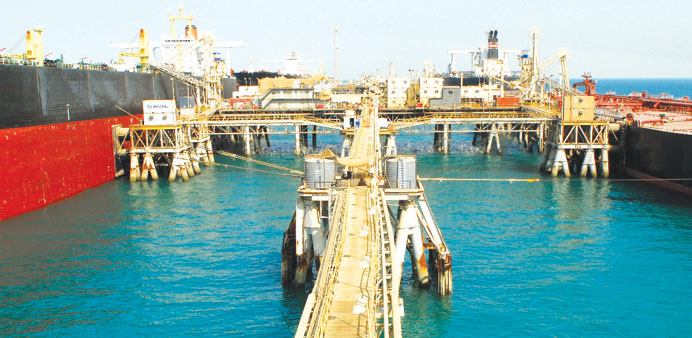
Three supertankers are connected to Iraq’s Basrah crude exports terminal (file). The country can export about 2.5mn bpd of crude from the port of Basrah and expects to return to that level this month after maintenance and bad weather cut shipments, Iraq’s deputy prime minister said yesterday.
Bloomberg/Daegu, South Korea
Iraq plans to raise production and boost oil exports to China and India next year after receiving requests for more, the country’s deputy prime minister said.
Opec doesn’t need to alter output because crude prices of about $100 a barrel are enticing marginal producers elsewhere to pump more, adding supply and stabilising markets, Iraq’s Hussain al-Shahristani said at the World Energy Congress in Daegu, South Korea, yesterday. China has asked for 900,000 bpd to 1mn bpd from Iraq, he said.
“Our increased production is mostly directed to Asia” where “China is the largest buyer of Iraqi crude,” al- Shahristani said. “The world is satisfied with current Opec production and we don’t see any reason, really, to change the production targets.”
Iraq is one the 12 members of the Organisation of Petroleum Exporting Countries, which pumps about 40% of the world’s oil and is scheduled to meet in December to review output levels. Current prices are “reasonable,” Algerian Energy Minister Youcef Yousfi said in Daegu on Tuesday.
Non-Opec producers led by the US, Canada and Kazakhstan will boost supplies next year by the most since the 1970s, reducing the need for Opec shipments, the International Energy Agency said in a monthly report last Friday.
Iraq was Opec’s second-largest producer last month, trailing Saudi Arabia, according to data compiled by Bloomberg. It can export about 2.5mn bpd of crude from its southern port of Basrah and expects to return to that level this month after maintenance and bad weather cut shipments, al-Shahristani said.
Iraq plans to raise crude-export capacity in the south to 4mn bpd by the end of the first quarter after completing a fourth floating terminal, he said. After that, it may begin repairs to fix damage at its onshore crude terminals, though the work has not been contracted out, he said, without giving a time line.
The country’s production is currently about 3.3mn bpd and will probably rise to 3.5mn bpd later this year, he said.
The nation plans to boost crude supply to China next year by about a third as the growing economy requests more fuel, Falah al-Amri, the head of Iraq’s State Oil Marketing Committee, or SOMO, said yesterday in Daegu.
While China requested as much as 1mn bpd, it will likely receive 800,000 to 850,000 bpd next year, compared with daily imports of almost 600,000 barrels this year, al-Amri said.
India, Iraq’s second-biggest consumer, has asked for “a little bit more” in 2014 than the 400,000 bpd it is receiving this year, al-Amri said. Some Indian companies have yet to submit their requests.
Iraq’s annual supply contract talks with buyers will conclude in late November or early December, he said.
Crude output in the country is set to rise as the Majnoon field reaches 175,000 bpd this month and 220,000 barrels before the end of the year, al-Shahristani said.
The start of production at the West Qurna-2 field is delayed to the first quarter. The country will boost production by 500,000 to 750,000 bpd next year and plans to reach a 9mn barrel daily production plateau by 2020. The level of output would be sustainable for 20 years and whether Iraq pumped that much would depend on demand, he said.
The call on Opec crude, or the amount the group needs to supply to meet global demand, will decline next year to less that what it is currently pumping, the IEA said in its monthly report last week.
Al-Shahristani said $100 a barrel “seems to be the right level” for prices.
If Iran resumes greater crude production and exports after US and European sanctions against its nuclear programme are lifted then other Opec nations that raised output to make up for that shortfall will have to cut production to accommodate Iran’s return to markets, al-Shahristani said, without naming the countries.
Opec’s 12 members are Algeria, Angola, Ecuador, Iran, Iraq, Kuwait, Libya, Nigeria, Qatar, Saudi Arabia, the UAE and Venezuela.