


Water is essential to life. Without it, we could not exist. It covers approximately seventy percent of the world’s surface, yet the vast majority of that is in the oceans, and isn’t drinkable. It’s estimated that only about 2.5 percent of the Earth’s water is salt-free and therefore suitable to quench our thirst.
Some of the drinkable water is in rivers and lakes, but a significant amount is stored in underground reservoirs. This is known as groundwater, and it’s estimated that 2 billion people worldwide rely on it as their primary drinking source, yet despite this, it has never been possible to measure how much groundwater there actually is on the planet.
Until now, the amount of water has been estimated for various underground reservoirs, known as aquifers, based on coarse approximations of their size and porosity. Despite their importance, they have not been carefully mapped in the way that oil fields have. In fact, in the majority of the world, the extraction of water from the aquifers is unregulated; as long as you have the money to drill a well, you can have unlimited access to this invaluable resource.
With the world’s ever-increasing population, the demand for water continues to rise, but the exact volume that remains in the aquifers remains unknown. Now, for the first time, scientists have been able to measure how much water is stored in the land, and the results are surprising. A joint project between researchers at NASA’s Jet Propulsion Laboratory and the University of California Irvine have discovered that the land has absorbed more water in the last decade than it has lost. The opposite of what I would have instinctively believed.
The new measurements have been taken by a pair of satellites known as GRACE. GRACE, which stands for Gravity Recovery and Climate Experiment, essentially consists of a pair of satellites that fly in tandem around the earth. The more dense an item is, the stronger the pull of gravity, so if a satellite is flying over a dense mountain, it will feel a stronger pull than if it is flying over a deep trench in the ocean. The difference in gravity is miniscule, but it’s enough to cause tiny changes in the path of a satellite, which can be detected by measuring the changes in distance between the two satellites.
The results are remarkably accurate, and by regularly mapping the Earth, the satellites can detect if anything has changed. Given that mountains generally remain where you left them, the researchers believe that any changes must be due to the change in water content of the land.
As well as an overall measurement of the amount of water contained in the land, the satellites have also been able to pinpoint exactly where the amount of water has increased and where it has decreased. The increases have been largely confined to a few isolated parts of the world, particularly the Amazon and the Zambezi, which have both recovered from drought.
Unfortunately the satellites also revealed that many other parts of the world have seen a decrease in groundwater. The major aquifers of Northwest India, North China and California have all experienced groundwater depletion, but the largest and most pronounced region includes the Middle East, with a huge swathe of land from Saudi Arabia to Russia showing a decline in groundwater.
The fact that the land has absorbed more water over the last decade is therefore not a reason to be cheerful. Our fellow man is still extracting more water than is sustainable, and as the groundwater levels drop, the quality of the remaining water will decrease and ever deeper wells will need to be dug.
At the same time, the land’s increased absorption of water has a direct effect on sea levels. Most people are aware that the Earth’s climate has warmed over recent decades. This has caused the sea level to rise, partly due to water which has been added to the sea from ice which has melted on the land, and also because as water warms, it expands.
Over the last century, sea level has risen at an average rate of 1.5mm per year, but over the last two decades this has increased to 3.2mm per year. However, had the land not absorbed more water than it lost, the rise in sea level could have been even greater. Researchers have estimated that it would have risen as much as 3.9mm per year.
In the future there is no guarantee that the land will continue to absorb water at its current rate and this would mean that the sea level would rise faster in the coming years. This is a cause for concern for many of the low-lying islands, such as the Maldives, the Marshall Islands and Vanuatu, which are believed to be most at risk from future sea level rises.
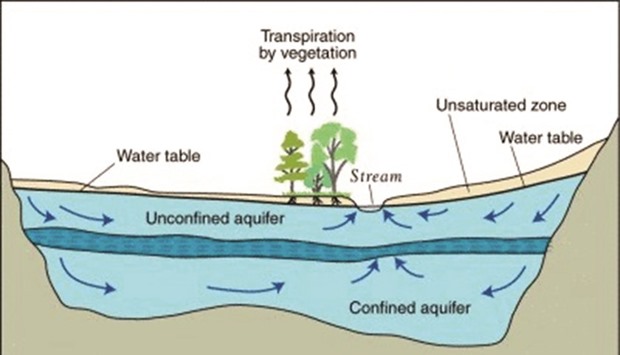
An illustration of how typical aquifers are. Illustration by Hans Hillewaert/Wikepedia