


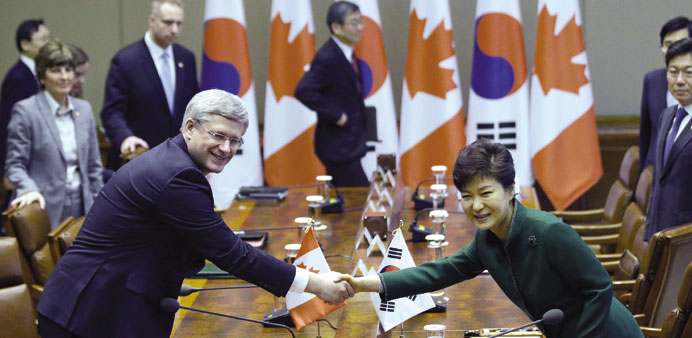
Canada’s Prime Minister Stephen Harper and South Korean President Park Geun-hye shake hands before their meeting at the presidential Blue House in Seoul yesterday. Both countries concluded a free-trade agreement yesterday, wrapping up a negotiating process that began nine years ago.
AFP/Seoul
South Korea and Canada concluded a free-trade agreement yesterday, wrapping up a negotiating process that began nine years ago and focused on barriers in the auto and agriculture sectors.
The South’s trade ministry said the FTA would be signed as early as June after legal reviews by both sides.
Talks between the two countries began in 2005 but suffered a five-year hiatus as Canada took South Korean restrictions on beef imports to a World Trade Organisation panel in 2009.
The trade ministry said South Korea’s auto industry would be the greatest beneficiary of the deal, which is the first FTA Canada has signed with an Asian country.
Canada is the world’s fifth-largest market for South Korean cars. Last year South Korea shipped $2.23bn worth of vehicles to Canada and imported $92mn worth of Canadian cars and parts.
South Korea agreed to completely remove its 8% import tariff on Canadian cars and parts after the FTA takes effect.
Canada will reduce 6.1% tariffs on South Korean cars and parts to four% within 24 months.
Canada will also remove most of its import tariffs on clothing and textile products, which now stand at a maximum of 18%, within two years.
The two countries will completely remove tariffs on 97.5% of products within 10 years from the day of implementation.
However, 19% of farm products including rice, cheese and dry milk will be either exempt from the deal or receive a grace period of more than 10 years, higher than the deals South Korea has already forged with the US and the European Union.
South Korea regards rice and beef as the most sensitive items.
Ford’s Canadian subsidiary lashed out yesterday at a new Canada-South Korea free trade deal it says will lead to a one-way flood of Korean-built Kia and Hyundai cars to Canada.
“We believe that South Korea will remain one of the most closed automotive markets in the world under the deal negotiated by the Canadian government,” Ford of Canada said in a statement.
The auto maker said it therefor “cannot support the Canada-South Korea free trade agreement.”
The criticism earned a sharp rebuke from Prime Minister Stephen Harper who accused the car maker of duplicity, citing Ford’s support for a US-South Korea trade pact two years ago.
Harper told reporters Ford secured “access through the US to the Korean market. What we are doing here is allowing other Canadian companies and other Canadian sectors to have the same access that Ford already has.
“So it is I don’t think realistic for a company to think it will have one set of rules for it, and another set of rules for the entire rest of the Canadian economy,” he added.
Canada is the world’s fifth-largest market for South Korean cars. Last year South Korea shipped $2.23bn worth of vehicles to Canada and imported $92mn worth of Canadian cars and parts.
Under the new trade pact announced in Seoul, South Korea agreed to completely remove its 8.0% import tariff on Canadian cars and parts.
Canada, meanwhile, will reduce 6.1% tariffs on South Korean cars and parts to four% within 24 months.
Ford’s concerns were echoed by Canada’s largest private sector union, Unifor, which warned that 33,000 manufacturing jobs could be lost in the trade deal with South Korea.