


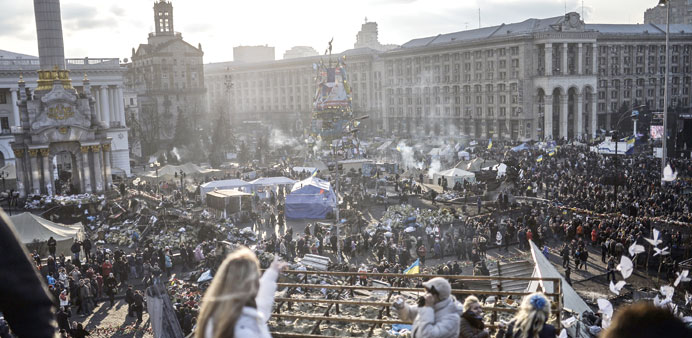
People observe the goings-on yesterday on Kiev’s Independence Square from a balcony. Ukraine has issued an arrest warrant for ousted president Viktor Yanukovych over the ‘mass murder’ of protesters and appealed for $35bn in Western aid to pull the crisis-hit country from the brink of economic collapse.
|
|
Ukraine has issued an arrest warrant for its ousted pro-Russia president over “mass murder” and appealed for $35bn in Western aid as Moscow denounced Kiev’s new reformist team as illegitimate.
The dramatic announcements by the ex-Soviet nation’s untested but enthusiastic Western-leaning ministers – approved by parliament over a chaotic weekend that saw president Viktor Yanukovych go into hiding – came as a top EU envoy arrived in Kiev to buttress Ukraine’s sudden tilt away from Russia.
Three months of relentless protests over Yanukovych’s shock decision to spurn an historic pact with the European Union in favour of closer ties with its old masters in the Kremlin culminated in days of carnage last week in Kiev that claimed almost 100 lives.
Russia reacted with outrage to the “mutiny” in a country with centuries-old roots to Moscow that President Vladimir Putin views as an integral part of an economic – and possibly even military – alliance counterweighting the EU and Nato blocs.
But Western powers have been cautiously throwing their weight behind the overthrow of a democratically elected leader by a parliamentary action whose constitutional legitimacy remains open to debate.
Ukraine’s new leaders hit the ground running yesterday by holding Yanukovych and about 50 other senior state and security officials responsible for the protester deaths.
“A criminal case has been launched over the mass murder of peaceful civilians. Yanukovych and a number of other officials have been put on a wanted list,” acting interior minister Arsen Avakov said in a statement.
Yanukovych had left a private residence in Balaclava, in the Russian-speaking Crimea, for an unknown destination by car with one of his aides and a handful of security guards, Avakov said.
Avakov said that Yanukovych had tried to flee the country on Saturday out of the eastern city of Donetsk – his political power base and bastion of pro-Russian support – before escaping to Crimea with a team of guards and a cache of weapons the next day.
He said the Yanukovych and his administration chief Andriy Klyuev had since “travelled by three cars into an unknown direction, having first switched off their modes of communication”.
Ukraine has been reeling from both political and financial crises that have seen the nation of 46mn face the threat of splintering between its pro-Western and more Russified regions and having to declare a devastating default.
World finance chiefs meeting in Sydney at the weekend raised the possibility of drumming up a huge rescue package that could fill in for $15bn promised to Yanukovych by Putin – money that is now on potentially permanent hold.
Ukraine’s interim finance minister Yuriy Kolobov said that the “planned volume of macroeconomic assistance for Ukraine may reach around $35bn (25bn euros)” by the end of next year.
Russia’s vocal displeasure at the changes convulsing its neighbour has translated into fears that Moscow’s massive rescue may be abandoned after only one payment of $3bn that came through in December and has been used up.
Russian Prime Minister Dmitry Medvedev issued one of Moscow’s firmest responses to date by condemning the “armed mutiny” in Ukraine (
“The legitimacy of a whole number of organs of power that function there raises great doubts,” he was quoted as saying by Russian news agencies. “Some of our foreign, Western partners think otherwise. This is some kind of (an) aberration.”
Russia’s finance minister added to the pressure by warning that Moscow would have to raise duties on its goods if Kiev reversed Yanukovych’s decision and still signed the EU partnership pact.
But a European Commission spokesman said such a deal could not be finalised until after Ukraine’s May 25 snap presidential election because this needed to be “a full sovereign choice”.
Ukraine’s new interim leader Oleksandr Turchynov warned that Kiev would have no alternative but to default on $13bn in foreign obligations due this year should the West fail to fill in for Moscow’s suspended aid.
Financial assistance from European powers was set to dominate the agenda of a two-day visit by EU foreign policy chief Catherine Ashton.
Ashton’s office said her talks yesterday with Ukraine’s interim leader focused on finding “a lasting solution to the political crisis and measures to stabilise the economic situation”.
The EU last year extended the promise of 610mn-euro ($840mn) loan if Kiev adopted a comprehensive economic restructuring package prescribed by the International Monetary Fund (IMF) – something that Yanukovych had mostly failed to do.
Economists believe a much larger figure may be coming Ukraine’s way despite EU leaders’ hesitance to take the politically unpopular decision of releasing vast sums of foreign assistance at a time of high unemployment and slow growth in their own countries.
London’s Capital Economics consultancy said Ukraine probably needed a bailout of around $20bn to sustain its finances over the next year.
Turchynov vowed on Sunday to draw up a “government of the people” and warned Russia that he expected the Kremlin to respect Ukraine’s pivot to the West.
He has until today to cobble together a coalition cabinet and find a prime minister willing to take up the challenge of keeping Ukraine from falling off the economic cliff before the presidential polls.
Turchynov is a close ally of Yulia Tymoshenko – an iconic but divisive former premier who was released by parliament on Saturday from a controversial jail sentence she was handed by Yanukovych’s team – and is not himself expected to run for the presidency.
Tymoshenko began to build up her credentials on Sunday by fielding a telephone call from German Chancellor Angela Merkel and meeting a string of Western ambassadors in Kiev.
However, her spokeswoman stressed that the 53-year-old – who had appeared before the crowds in a wheelchair on Saturday because of back problems – had made no decision about running in May.
Russia recalled its ambassador from Kiev for consultations on Sunday, accusing the opposition of having torn up a transition agreement with the president it supported.
In a sign of nervousness over how Moscow may react, Oleh Tyahnybok, a far-right nationalist who was one of three opposition leaders who negotiated with Yanukovych on Friday, said the defence ministry should check out reports that Russian troops might gather on Ukraine’s border.
He gave no details and did not suggest such troop movements had actually taken place. Interfax news agency later quoted Ukrainian border guards as saying there was no sign of any Russian troop movements near the border.
Tyahnybok said a boat was due to arrive in the Crimean port of Sevastopol with 200 Russian commandos.
Russia’s Black Sea fleet is based in Sevastopol and its forces come and go freely. It was not clear whether this was a long-scheduled arrival.
President Barack Obama’s national security adviser, Susan Rice, was asked on US television about the possibility of Russia sending troops to Ukraine.
“That would be a grave mistake,” Rice said on Sunday. “It’s not in the interests of Ukraine or of Russia or of Europe or the US to see a country split.”
British Foreign Secretary William Hague was asked if Russia might “send in the tanks” to defend its interests.
“It would really not be in the interests of Russia to do any such thing,” he told the BBC.
Earlier this month, a Kremlin aide had warned that Moscow could intervene.
It is unlikely the US and its allies in Nato would risk an outright military confrontation with Russia, but such echoes of the Cold War underline the high stakes in Ukraine.