


AFP/Amman
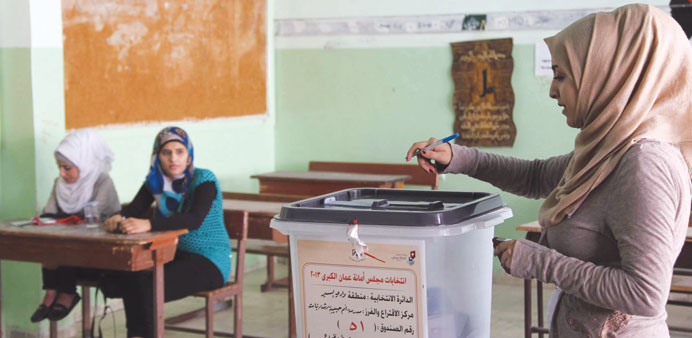
Jordan’s municipal elections drew a poor turnout yesterday with the impact of a huge refugee influx from neighbouring Syria on a struggling economy stoking voter resentment and apathy.
Interior Minister Hussein Majali expected a voter turnout of around 30%.
“The final results will not be frustrating. These are municipal elections and it is normal that people would be less interested in them,” Majali told reporters.
Polls opened at 7am and officially closed at 5pm.
In Amman, however, voting was extended by two hours, and polling stations also closed one hour late in several other regions.
Under the law, electoral officials in each governorate can independently extend voting hours if the need arises.
Earlier, Ahed Ziadat, a spokesman for the municipal affairs ministry, said that “after eight hours of voting the turnout was 21%, and 500,000 people voted.”
“The turnout was low this year compared to 2007. Some institutions, like the armed forces and security forces, did not vote.”
In 2007, more than 50% of the registered electorate took part.
“Maybe the general mood and regional circumstances are the reason (behind the poor turnout),” Minister of Municipal Affairs Walid Masri said.
The Muslim Brotherhood, the main opposition party, boycotted the polls, charging that, despite repeated promises since the Arab Spring of 2011, there is no real readiness for change.
“Anyone who boycotts the polls affects the turnout and contributes to electing weak candidates,” Ziadat said.
With few candidates of the leftist or nationalist opposition standing, tribal figures, who are the traditional bedrock of the monarchy, are set to sweep the elections.
“Jordan held parliamentary elections in January and today people are voting in municipal elections. It is an achievement for democracy and reform in this turbulent region,” Prime Minister Abdullah Nsur told reporters after he voted in his northwestern hometown of Salt.
But the election has been overshadowed by anger among Jordanians over the impact of more than 500,000 Syrian refugees on their lives and country, with its population of just 6.8mn.
Officials say the influx has placed a huge burden on already overstretched water and power supplies as well as housing and education.
Also, the government has announced a raft of austerity measures as it battles to reduce a $2bn deficit this year and rein in a foreign debt that now exceeds $23bn.
Last month, it doubled taxes on cellphones and mobile telephone contracts, and it also plans to raise the price of electricity by 15%.
“We are suffering from the large number of Syrian refugees. We have additional water and electricity problems as well as obstacles in finding jobs,” said Odai Khendi, before voting in the northern city of Ramtah, home to a large community of Syrian refugees.
“I am voting today to help improve our situation. Our demands for help are not political.”
Khitam Rodan, from the city of Mafraq, which is hosting tens of thousands of Syrian refugees in the north, agreed.
“Our situation is disastrous. We need a solution,” she said.
The desert Zaatari refugee camp, home to more than 150,000 Syrians, is located 10km east of Mafraq.
In the mainly Christian city of Fuheis, west of Amman, supporters of candidates offered Arabic coffee to voters amid normal traffic and a low-key security presence.
“I know the country is going through difficult times, but I want to vote and choose the right person to help the city,” Widad Issa, 85, told AFP after her grandson helped her vote in Fuheis.
Some 3.7mn Jordanians were registered to vote in the elections, to select 100 mayors and 970 municipal councillors from about 3,000 candidates in 94 municipalities.
The electoral law reserves 297 municipal council seats for women.