


Reuters/Berlin
|
|
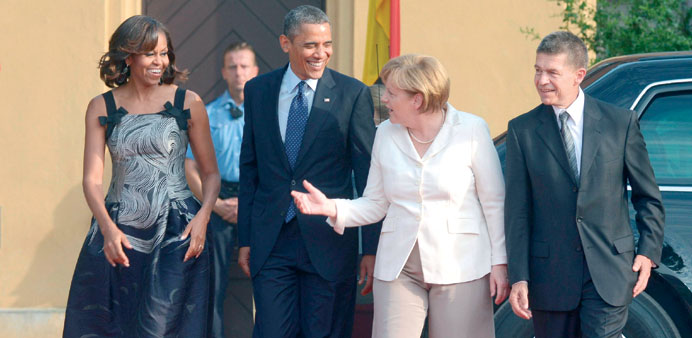
President Barack Obama defended US anti-terrorism tactics on a visit to Berlin yesterday, telling wary Germans Washington was not spying on the e-mails of ordinary citizens and promising to step up efforts to close the Guantanamo Bay prison.
On the 50th anniversary of John F Kennedy’s famous “Ich bin ein Berliner” speech, Obama made his first presidential visit to the German capital, a favoured destination of US leaders during the Cold War.
He held talks with Chancellor Angela Merkel and gave a speech at the Brandenburg Gate in which he unveiled a proposal for new talks with Russia on slashing nuclear arms arsenals.
Obama, who attracted a crowd of 200,000 adoring fans when he last passed through in 2008 during his first campaign for the presidency, remains popular in Germany.
But revelations before the trip of a covert US Internet surveillance programme, code-named Prism, caused outrage in a country where memories of the eavesdropping East German Stasi secret police are still fresh.
Merkel said at a joint news conference that also touched on Afghanistan, Syria and the global economy, that the two leaders had held “long and intensive” talks on the spying issue, noting that some questions still needed to be cleared up.
Obama tried to reassure his host, who as a pastor’s daughter growing up in the communist East experienced the Stasi first-hand.
“This is not a situation in which we are rifling through the ordinary e-mails of German citizens or American citizens or French citizens or anybody else,” Obama said.
“This is not a situation where we simply go into the Internet and start searching any way we want. This is a circumscribed system directed at us being able to protect our people and all of it is done under the oversight of the courts.”
In a message which seemed designed for her domestic audience, Merkel told Obama that balance was essential in government monitoring of Internet communications.
“I made clear that although we do see the need for gathering information, the topic of proportionality is always an important one and the free democratic order is based on people feeling safe,” said the 58-year-old chancellor.
Obama countered that the US had thwarted at least 50 threats because of its monitoring programme, including planned attacks in Germany.
“So lives have been saved and the encroachment on privacy has been strictly limited,” he said.
A poll last week showed 82% of Germans approve of Obama, but the magic of 2008, when he was feted like a rock star, has faded amid concerns about his anti-terrorist tactics.
In his speech to 4,000 invited guests at the Brandenburg Gate, Obama harked back to Kennedy by stressing what he called common values of openness and tolerance.
“We can be a little more informal among friends,” he joked as he took off his jacket in the sweltering sun on the Pariser Platz square, just east of the Gate that once stood alongside the Berlin Wall dividing the communist East from the capitalist West of the city.
Obama arrived in Germany after a two-day summit with Group of Eight leaders in Northern Ireland where he and other leaders clashed with Russian President Vladimir Putin over Syria.
Despite these divisions, he said he would engage with Moscow on reducing deployed nuclear weapons by up to a third from previously agreed levels.
“I intend to seek negotiated cuts with Russia to move beyond Cold War nuclear postures,” Obama said.
In 2008, Merkel refused to allow Obama, then a senator from Illinois, to speak at the Brandenburg Gate because he was not yet president.
Despite this awkward start, the Democrat has forged a pragmatic relationship with the conservative Merkel, who may be hoping for a political boost out of the visit months before a German election.
In a nod to criticism, Obama defended his failure to close the Guantanamo Bay prison on Cuba that his predecessor George W Bush opened after the invasion of Afghanistan in 2001, shortly after the Sept 11 attacks in New York and Washington.
He also reassured Germans that the US military was not using German bases to launch unmanned drone attacks.
For Obama, who grew up in Hawaii and spent part of his childhood in Indonesia, Europe has sometimes seemed an after-thought. The signature foreign policy initiative of his first term was his “pivot” to Asia.
But analysts say plans to create a free-trade zone between the US and European Union are a sign that he is focusing more on Europe.
“The Obama administration has found it harder than expected to work with emerging powers and has fallen back to a more traditional reliance on European allies,” said Charles Kupchan, professor of international affairs at Georgetown University.