


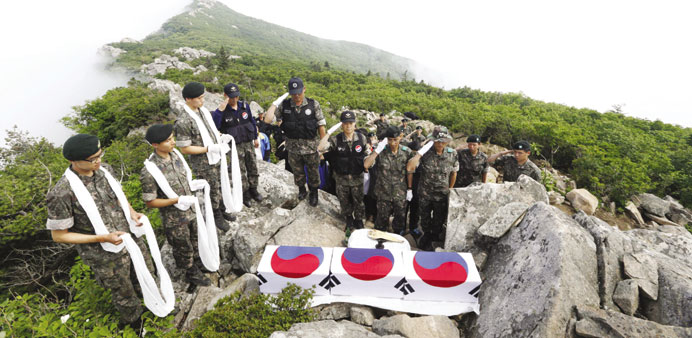
Soldiers salute during a temporary sacrificial ritual after exhuming the remains of three South Korean soldiers, believed to have been killed by North Korean soldiers during the 1950-53 Korean War, at an excavation site on the summit of Sang. The 1,290m high peak, in Goseong, about 200km northeast of Seoul, was one of the battlefields of the Mount Seorak combat during the war. According to the Agency for KIA (Killed in Action) Recovery and Identification of South Korean Defence Ministry, about 160,000 South Korean soldiers were killed or were reported missing during the war and the bodies of 130,000 among them, were not collected since the Korean War ended with an armistice.
Reuters/Beijing
A top North Korean diplomat yesterday repeated an offer for international talks over his country’s disputed nuclear programme during a meeting in China, saying the denuclearisation of the peninsula was the “dying wish” of North Korea’s founder.
The Beijing trip by First Vice Foreign Minister Kim Kye-gwan comes just days after North Korea offered talks with the US to ease tension that spiked this year when the North threatened the US and South Korea with nuclear war.
The White House said any talks must involve action by the North to show it is moving towards disarmament.
China’s Foreign Ministry, after Kim’s talks with Chinese Vice Foreign Minister Zhang Yesui, cited the North Korean, who has previously represented his country at talks to get it to halt its nuclear programme, as saying North Korea wanted talks.
“The denuclearisation of the Korean peninsula was the dying wish of Chairman Kim Il-sung and General Secretary Kim Jong-il,” the Chinese ministry said in statement, citing Kim as saying.
Kim Il-sung founded the country. His son Kim Jong-il, who died in 2011, oversaw North Korea’s first two nuclear tests. North Korea conducted a third test in February.
“North Korea is willing to have dialogue with all sides and attend any kind of meeting, including six-party talks, and hopes to peacefully resolve the nuclear issue via negotiation,” Kim Kye-gwan was cited as saying.
Zhang said that talks, stability and the denuclearisation of the Korean peninsula were in everyone’s best interests, China’s Foreign Ministry added.
“China supports talks between the various parties and hopes for an early resumption of the six-party talks,” Zhang said.
China has repeatedly urged North Korea to return to so-called six-party talks that aimed to get the North to halt its nuclear programme.
In 2009, North Korea said it would never return to those talks. The four other participants in the negotiations were South Korea, the US, Japan and Russia.
The White House said any talks must involve action by North Korea to show it is moving towards disarmament.
North Korea was looking for holes in the international consensus that it must denuclearise by seeking dialogue with various countries, said Wang Dong, an international relations professor at Peking University in Beijing.
“If China’s stance is still firm, North Korea will understand that there are no loopholes to exploit,” Wang said.
“You can’t have your cake and eat it too. I think China will make this clear to North Korea,” he said, referring to Pyongyang’s refusal to give up its nuclear weapons while at the same time trying to mend ties with key powers.
The talks are the highest-level contact between China and North Korea since US President Barack Obama and Chinese President Xi Jinping met in California in early June and agreed that North Korea had to denuclearise.
North Korea has repeatedly said it will never abandon its nuclear weapons, calling them its “treasured sword”, a term one of its official newspapers used again on Wednesday.
Late last month, North Korean leader Kim Jong-un sent another envoy to Beijing. According to a source with knowledge of that visit, Chinese officials gave the envoy a lukewarm reception while saying Beijing wanted an end to the North’s nuclear and missile tests.
Li Bin, a nuclear policy expert at the Carnegie-Tsinghua Centre for Global Policy in Beijing, said he did not believe North Korea was ready to discuss its nuclear programme with China.
“But now they see that China is very serious with sanctions and is very angry. My guess is that they are coming to Beijing to avoid a situation in which the relationship between the two countries gets worse,” he said.
China, the closest thing Pyongyang has to a major ally, backed the latest round of UN sanctions on North Korea, imposed for its February 12 nuclear test. Some Chinese banks have also curtailed ties to their North Korean counterparts in the wake of a US crackdown on the North’s finances.
Next week, South Korea’s President Park Geun-hye visits China, where North Korea is likely to be high on the agenda.
Washington has been sceptical of any move by Pyongyang towards dialogue as it has repeatedly backtracked on deals, most recently in 2012, when it agreed to a missile and nuclear test moratorium only to fire a rocket a few weeks later.
South Korea to buy bunker-busting missiles from Europe
South Korea will buy European bunker-busting missiles as the US refused to sell the same kind of weapons to the country, the state procurement agency said yesterday.
At a meeting presided over by Defence Minister Kim Kwan-Jin, the Defence Acquisition Program Administration (DAPA) approved a plan to purchase air-to-ground missiles with a 500km range from the German-Swedish joint venture Taurus System.
The number of missiles and proposed budget have not been confirmed yet, it said. But Yonhap news agency said South Korea planned to buy about 170 Taurus bunker busters worth more than $300mn in total, AFP reports from Seoul.
Launched from a relatively safe distance from the enemy, the GPS-guided cruise missiles can hit strategic targets with precision, DAPA said in a press statement.
“The long-range air-to-ground missiles will add to our strategic assets, bolster deterrence against war and drastically enhance survivability of the aircraft and pilots as well”, DAPA said.
Currently, the only long-range missiles in the Air Force’s inventory are 40-odd SLAM-ER missiles with a range of 278km, Yonhap said.
DAPA had planned to choose between Taurus and Joint Air-to-Surface Standoff Missiles (JASSM) by US giant Lockheed Martin.
But the Pentagon has not approved the sales of the 370km range missile, classified as a strategic weapon, to South Korea.
“In the face of mounting threats from North Korea, we need to acquire them at an earliest possible date. However, the acquisition of JASSM has become infeasible due to the US government’s decision”, DAPA said.