


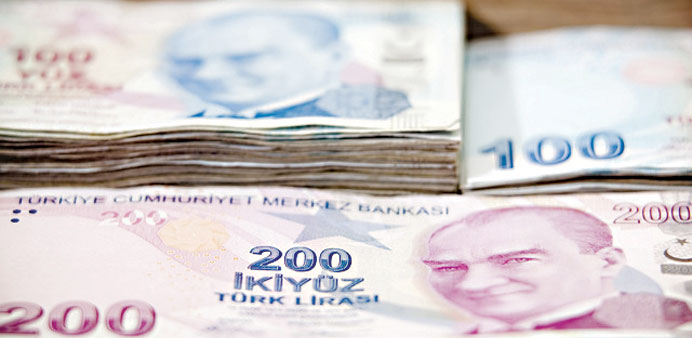
The lira on June 11 hit its weakest level against its euro/dollar basket since October 2011. The central bank stepped in on the same day and eased pressure by holding forex-selling auctions, and said it would intervene directly in the foreign exchange market if needed.
Reuters/Istanbul
Turkey’s central bank kept interest rates on hold yesterday but said capital inflows had fallen and hinted it could act again to support the lira, under pressure from domestic unrest and uncertain global liquidity conditions.
Turkish assets have been volatile since the end of May as anti-government protests flared, unnerving investors already worried by an expected slowdown in the flow of cheap money from major economies including the US.
The bank kept its main policy rate, the one-week repo rate, at 4.50%, its borrowing rate at 3.5% and overnight lending rate at 6.5%.
“Ongoing uncertainties regarding the global economy and the volatility in capital flows necessitate monetary policy to remain flexible in both directions,” the bank said in a statement after its policy meeting yesterday.
It said it would make adjustments in its provision of lira liquidity as needed.
The bank has already moved to ease pressure on the currency, selling foreign exchange at auctions last week and pledging to keep monetary policy tight if need be.
The protests, which spiralled out of a campaign against plans to build on an Istanbul park, pose no immediate threat to Prime Minister Tayyip Erdogan’s government, but they have tarnished Turkey’s image as a stable oasis.
The unrest initially spooked investors, with the lira currency hitting near-two-year lows last week and 10-year bond yields climbing above 8%, but markets have since settled close to levels before the protests began.
Central bank governor Erdem Basci said last week that about $7.9bn to $8.0bn had flowed out of Turkish markets since the beginning of May, mainly from money markets.
Both the lira and the yield on the two-year benchmark bond were broadly unchanged after Tuesday’s interest rate decision.
“They did additional tightening last week, and here they say it again ... they’ll apply additional tightening if needed,” said Tufan Comert, strategist at Garanti Securities. “But it’s not new for the market so there’s no need for repricing ... We’ll continue to wait for the Fed decision.”
The US Federal Reserve’s indication that it may slow down its massive bond-purchasing programme has exacerbated the risk of accelerated capital outflows from Turkey, as some of the money the Fed has been pumping into US bonds has seeped into Turkish and other emerging markets.
The Fed started a two-day meeting yesterday and markets are on alert for guidance on when and how quickly it could start winding down its bond buying.
Turkey’s central bank embarked on a series of rate cuts last September in a bid to boost growth which slowed to 2.2% last year. It cut all of its key rates last month.
The lira on June 11 hit its weakest level against its euro/dollar basket since October 2011. The central bank stepped in on the same day and eased pressure by holding forex-selling auctions, and said it would intervene directly in the foreign exchange market if needed.