


Agencies/Enniskillen, Northern Ireland
Russia and the US both want to stop the violence in Syria and have agreed to push all parties in the conflict to hold peace talks in Geneva, President Vladimir Putin said yesterday.
Speaking after bilateral talks with US President Barack Obama at the G8 summit, Putin said: “Of course our opinions do not converge, but all of us have the intention to stop the violence in Syria.
“And to solve the situation peacefully including by bringing the parties to the negotiating table in Geneva.
“We agreed to push the parties to the negotiating table.”
World powers have for months been discussing an international peace conference in Geneva to build on a similar conference in the Swiss city last year that aimed to end the violence in Syria.
Obama acknowledged that they had “different perspectives” but shared an interest in reducing the bloodshed in Syria.
“With respect to Syria we do have different perspectives on the problem,” said Obama, as he and Putin sat in armchairs and delivered statements after their talks.
“But we share an interest in reducing the violence, securing chemical weapons and ensuring that they are neither used nor are they subject to proliferation, and that we want to try to resolve the issue through political means if possible,” he said.
“So we will instruct our teams to continue to work on the potential of a Geneva follow-up.”
Obama and Putin will hold bilateral talks in Moscow on September 3-4, ahead of the G20 summit in St Petersburg on September 5-6, they said in a communique.
British Prime Minister David Cameron, who is chairing the G8 summit in a remote golf resort in Northern Ireland, conceded there was “a big difference” between the positions of Russia and the West on how to resolve the war.
In some of his most colourful remarks on Syria, Putin described anti-Assad rebels as cannibals who ate human flesh and warned Obama of the dangers of giving guns to such people. Moscow also said it would not permit no-fly zones over Syria.
For their part, Western leaders have criticised Russia for sending weapons to Assad forces and considering deliveries of a sophisticated missile system.
“How can we allow that Russia continues to deliver arms to the Bashar al-Assad regime when the opposition receives very few and is being massacred?” French President Francois Hollande said.
Stung by recent victories for Assad’s forces and their support from Hezbollah guerrillas, the US said last week it would step up military aid to the rebels including automatic weapons, light mortars and rocket-propelled grenades.
In an apparent response to this development, Assad said Europe would “pay the price” if it delivered arms to rebel forces, saying that would result in the export of terrorism to Europe.
“Terrorists will gain experience in combat and return with extremist ideologies,” he said in an advance extract of an interview due to be published in the Frankfurter Allgemeine Zeitung today.
The European Union has dropped its arms embargo on Syria, allowing France and Britain to arm the rebels, though Cameron expressed concern about some of Assad’s foes.
“Let’s be clear - I am as worried as anybody else about elements of the Syrian opposition, who are extremists, who support terrorism and who are a great danger to our world,” Cameron said.
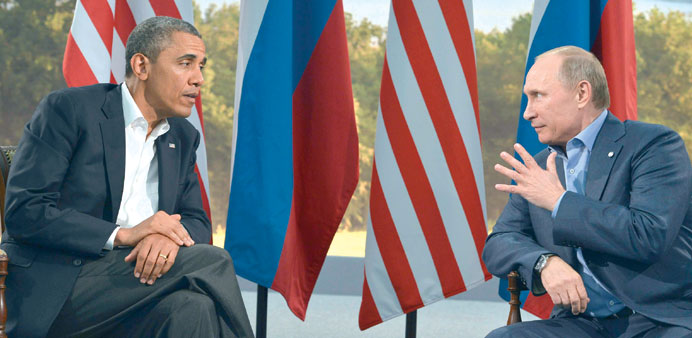
Obama and Putin hold talks near Enniskillen yesterday.