


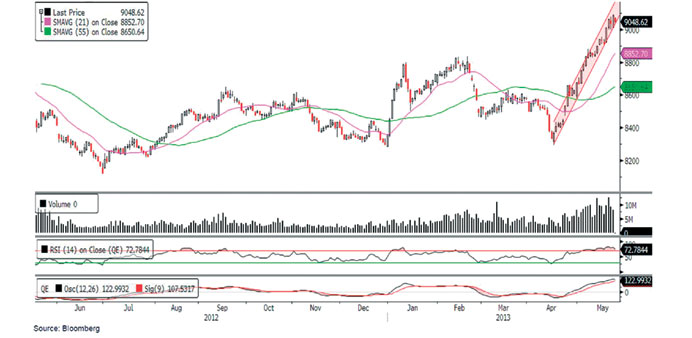
Technical analysis of the QE index
The QE Index witnessed some profit booking on Thursday to close the week at 9,048.62, down about 37 points (0.4%) for the day. On a weekly basis, the Index continued its winning streak for the fifth consecutive week, gaining about 1.5% (132 points), and touching a new 2-year high of 9,094.15. The momentum indicators suggest that the index may experience some profit-booking in the short-term. The RSI (Relative Strength Index) is in the overbought zone, and is beginning to move lower. Further, the MACD (Moving Average Convergence Divergence) is also converging with the signal line in a bearish manner, indicating tiredness of the bull move. On Thursday, the index closed near the lower end of its bullish trend channel. We believe a close below this channel would lead to consolidation in the index. Nevertheless, the medium-term uptrend in the index is still intact, with no strong resistance until the 9,290.0 level (its January 2011 high). On the downside, the 9,000.0 level is an important psychological mark. After that the next significant support is around the 8,875.0 level.
Definitions of key terms used in technical analysis
SSI (Relative Strength Index) indicator – RSI is a momentum oscillator that measures the speed and change of price movements. The RSI oscillates between 0 to 100. The index is deemed to be overbought once the RSI approaches the 70 level, indicating that a correction is likely. On the other hand, if the RSI approaches 30, it is an indication that the index may be getting oversold and therefore likely to bounce back.
MACD (Moving Average Convergence Divergence) indicator – The indicator consists of the MACD line and a signal line. The divergence or the convergence of the MACD line with the signal line indicates the strength in the momentum during the uptrend or downtrend, as the case may be. When the MACD crosses the signal line from below and trades above it, it gives a positive indication. The reverse is the situation for a bearish trend.
Candlestick chart – A candlestick chart is a price chart that displays the high, low, open, and close for a security. The ‘body’ of the chart is portion between the open and close price, while the high and low intraday movements form the ‘shadow’. The candlestick may represent any time frame. We use a one-day candlestick chart (every candlestick represents one trading day) in our analysis.
Doji candlestick pattern – A Doji candlestick is formed when a security’s open and close are practically equal. The pattern indicates indecisiveness, and based on preceding price actions and future confirmation, may indicate a bullish or bearish trend reversal.