


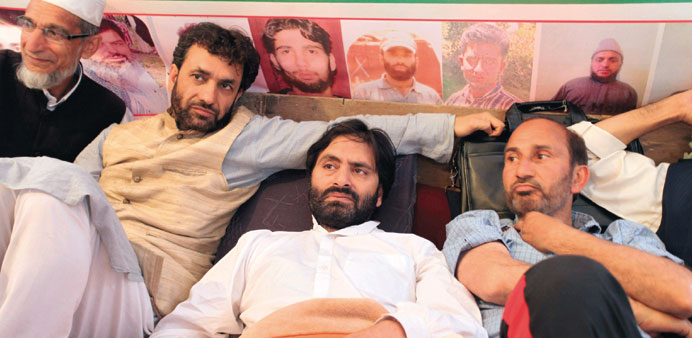
Jammu and Kashmir Liberation Front (JKLF) chairman Yasin Malik (centre) sits with supporters during the second day of a 48hour-long hunger strike in Srinagar yesterday. Malik and dozens of his supporters began the hunger strike outside their party headquarters to press for the return of the mortal remains of parliament attack convict Mohamed Afzal Guru and party founder Mohamed Maqbool Bhat.
IANS/Jammu
A militant and his family who returned illegally to Jammu and Kashmir from Pakistan have been arrested, police said.
“We had reports two days back that this militant, Nazir Hussain, was returning from Pakistan via Nepal to his home at Marhot in Poonch district,” Senior Superintendent of Police Shamsher Choudhary said late Friday.
The police were waiting to arrest the man, as he had returned without following the procedure announced under the rehabilitation policy for ex-militants.
“We caught him at Jogi Morh, just before he could make it to his village,” the police officer said.
Hussain, 30, was arrested along with his Pakistani wife and three children, aged between two and six.
Choudhary said: “All of them are in police custody and we are interrogating Nazir.”
The militant had illegally crossed over to Pakistan-ruled Kashmir in 2001, along with a group of people who were to undergo training in handling arms to join the rank of militants. He was trained at Nakhial camp, and had returned to Poonch, where he was active as a militant. He later joined the Harkat-ul-Jehad-e-Islami (HuJI).
He later left militancy to work as a taxi driver in Karachi. It was in Karachi that he married Rifat Bibi.
“He had recently come back to Pakistan-ruled Kashmir, from where he managed to get a Pakistani passport. He then flew to Kathmandu from Karachi on May 21. He entered India from Uttar Pradesh and reached Poonch district yesterday (Thursday),” Choudhary said.
This is third instance in the last one year of a militant being arrested with his family in Poonch and Rajouri districts on return from Pakistan.
In 2009, the Jammu and Kashmir government announced a rehabilitation policy for Kashmiri youth who had crossed over to Pakistan for arms training to become militants, provided they were “willing to shun violence,” and took the route of return prescribed by the government.
The relatives of such militants residing in the state could apply on behalf of the youth, many of whom were stranded in Pakistan. The state government considers the merit of each application.
Chief Minister Omar Abdullah, who also holds the home portfolio, said in the legislative assembly in March this year: “The state government has received 1,089 applications on behalf of ex-militants, out of which 191 cases have been recommended for return. Not a single militant has returned to Jammu and Kashmir through routes identified by the government. The rest of the applications are being scrutinised and verified.”
Two hundred and sixty-two ex-militants returned to the state via Nepal and other routes, in the hope of getting the benefit of the rehabilitation policy announced by Abdullah.
The chief minister clarified: “They are not entitled to benefits under the return and rehabilitation policy, as they have not returned through the identified route and followed the norms set therein.”
In a related development, Abdullah expressed confidence of warm ties with Pakistan due to a “positive approach” by Nawaz Sharif’s party which won the recent elections.
Abdullah said: “A healthy change in the mindset of politicians in Pakistan towards Kashmir issue and India-Pakistani relations has also been clearly observed during the recent electioneering process in that country.”