


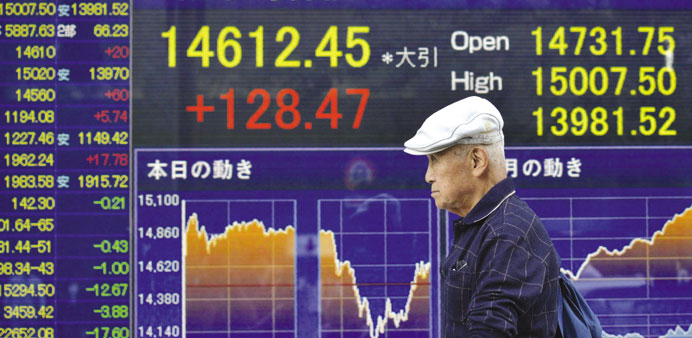
A man walks past a stock market indicator board in Tokyo, Japan, yesterday. Tokyo, which plunged 7.3% in the previous session during frenzied selling, ended up 0.89%, or 128.47 points, at 14,612.45, yesterday.
Reuters/London
Investors betting on a continuation of Japan’s six-month runaway bull market suffered their biggest scare yet on Thursday as the Nikkei 225 lost more than 7% — its largest one-day loss in more than two years.
But a corresponding spike in the Nikkei Volatility Index, from 27 to 48, translated into bumper derivatives activity, ensuring that the Japan story remains one of the year’s most important revenue-drivers for equity derivatives flow desks.
The dramatic shift reignited concerns about the strength of a rally that has seen the Nikkei gain more than 60% since the start of the year, on the back of a stimulus package of at least ¥120tn (US$1.19tn) intended to boost inflation to 2% over the next two years.
“The move seems to be technical as Japan is up almost 15% this month, so it seems to be a natural correction,” said Murray Roos, co-head of equities, EMEA at Deutsche Bank. “Sell-offs in bull markets are always violent and there’s a lot of leverage in Japan right now as investors have borrowed money to buy the market, so any moves have been exacerbated.”
In addition to the technical drivers, concerns have risen regarding global growth and a potential end to central bank intervention. Hawkish comments from Federal Reserve chairman Ben Bernanke triggered a weak S&P 500 close on Wednesday, while Chinese PMI figures released on Thursday morning by HSBC came in below analyst expectations at 49.6 — the lowest level since October.
But amid the huge swings, equities specialists remained calm, with many still expecting further upside. Prior to the fall, analysts at BNP Paribas upgraded their year-end Nikkei target to 18,000 after the index surged beyond the bank’s previous 15,000 target to hit a 5.5-year high of 15,942 on Thursday morning. “This kind of sharp sell-off is often a feature of a market with strong momentum. In the last few weeks we’ve seen enormous acceleration but it has been a little too quick and it hasn’t all come on the back of real money,” said Alvise Munari, global head of equity sales and structuring at Morgan Stanley.
“If you look at open interest in the futures market, a lot of new longs have been established around the 14,000 to 15,000 range and even further up, and a lot of it was leveraged money. When it comes down, it comes down very fast.”
The shattering of the upward momentum only added to the increased activity that equity and derivatives desks have reported over recent months. According to an equity derivatives head at one European house, Japanese equity derivative flows enjoyed one of the most active days yet on Thursday, with billions of dollars’ worth of trades that included pension funds selling volatility, both outright and via spreads.
“Higher volatility means you’ll see less keen buyers of outright calls and more interest in spreads,” said Munari. “That means there will be less leveraged delta in the market, which will still help the market nudge up, but more gently from these levels.”
Continued upside seemed to be the view of hedge funds, which took advantage of lower levels to buy upside calls, while asset managers took the opportunity to sell back their hedged calls, as many traders noted that the smart money was buying rather than selling through the turmoil, which failed to put more than a slight dent in upside expectations.
“It still wouldn’t be surprising for the rally to continue and the Nikkei to hit 18,000 by year-end, but for the yen to get past 110 might be more of a battle,” said Roos at Deutsche.
However, a continued strong performance is far from certain. Prime Minister Shinzo Abe’s policies may have already had an unprecedented impact across Japan’s financial markets, with the yen slumping in value from ¥77 against the dollar last September to a high of ¥103.5 on Thursday morning, but the real economic impact remains unclear.
“The first bullish wave was driven by expectations of political change, which happened; the second by the promise of monetary, fiscal and structural change, which started well with very aggressive policy pronouncements by the BoJ. But we’re now in a new phase where the markets will start to question whether all of this will be followed through and whether it will have the impact that people are pricing in,” said Munari. “Nobody knows for sure whether it will work in practice.”
Swings in govt bonds could trigger sell-off
Extreme volatility in the Japanese government bond market could trigger a sell-off on a par with what happened throughout the third quarter of 2003, when local banks and foreign investors were forced to dump their JGB holdings after heightened volatility caused the assets to exceed internal value-at-risk (VaR) limits.
According to analysts at JP Morgan, the threat of a so-called “VaR shock” highlights one of the unintended consequences of quantitative easing, and the situation could be exacerbated this time around.
“The proliferation of risk parity investors and funds, which are strict value-at-risk investors and are heavily invested in bonds currently, is likely raising the sensitivity of bond markets to self-reinforced volatility-induced selling,” said Nikolaos Panigirtzoglou, head of flows and liquidity for Europe at JP Morgan, in a report.
Last month, Japan’s central bank confirmed plans for a ¥13tn ($127.7bn) liquidity injection that is intended to boost inflation to 2% over the next two years. The result has been a surge in JGB volatility and rising yields on anticipation of widespread shift from fixed-income to equities.
“It’s an example of the pro-cyclicality of markets. Those with mechanical VaR-based limits will increase positions as vol reduces, and cut positions as vol increases, just like in 2003,” said Guillaume Amblard, global head of fixed-income trading at BNP Paribas.
“It creates a snowball effect and it’s exacerbated by the fact that there are some big leveraged positions in JGBs.”
JP Morgan analysts note that 60-day standard deviation of the daily changes in 10-year JGB yields has doubled to 4bp since the BoJ confirmed its monetary easing strategy on April 4 — the highest level since 2008.
Those levels remain some way from where the 2003 sell-off was triggered. At that time, 60-day standard deviation jumped from 2bp to more than 7bp between June and September as 10-year yields tripled from 0.56% to 1.58%.
However, the strength of the current equity bull market and corresponding pressure on JGBs could drive large shifts relatively quickly. Since the liquidity injection was confirmed in early April, 10-year yields jumped from 0.5% to hit a one-year high of 0.895% last Wednesday.
“We think that hitting 1% on the 10-year JGB will prove to be an important psychological level. There’s still some way to go, but we wouldn’t be surprised to [see a] test very soon. It’s a very strong bear market that we’re seeing,” said Mathieu Gaveau, global head of IR options, solution and inflation trading at BNP Paribas.
Whether the situation now is directly comparable to 2003 is a matter of debate, especially bearing in mind the safety net provided by central bank intervention.
Asian markets mixed in volatile trade
Asian markets were mixed yesterday in rollercoaster trade after routs sparked in part by fears of tighter US monetary policy, with Tokyo ending higher a day after suffering its worst drop since the March 2011 quake-tsunami disaster.
Tokyo, which plunged 7.3% in the previous session during frenzied selling, ended up 0.89%, or 128.47 points, at 14,612.45.
The Nikkei had bounced back in the morning but plummeted by as much as 3.37% after lunch before regaining ground.
Seoul closed up 0.22%, or 4.26 points at 1,973.45. Sydney dropped 1.56%, or 78.9 points, to end the day at 4,983.5, after its worst week of trading for a year.
Hong Kong stocks closed down 0.23%, or 51.01 points, at 22,618.67, but Shanghai finished up 0.57%, or 12.86 points, at 2,288.53.
The volatility in Asia came after US stocks ended slightly lower Thursday, with the Dow Jones Industrial Average falling 0.08%, or 12.67 points, to 15,294.50, with Wall Street boosted by better-than-expected US housing and jobless data.
Toshikazu Horiuchi, a broker with IwaiCosmo Securities in Japan, said “extremely nervous” trading saw some investors lock in profits with others searching out bargains after Thursday’s plunge.
Japanese stocks were also tracing zigzagging yen movements, with a weak yen tending to boost the market.
The dollar was at 101.60 yen late in Asia compared to 101.82 yen Thursday in New York.
The euro was at ¥131.66 from ¥131.72 in New York and at $1.2960 from $1.2935.
New York’s main contract, West Texas Intermediate light sweet crude for July, was up four cents at $94.29 a barrel and Brent North Sea crude was down six cents at $102.38.
There was no trading yesterday in Singapore, Bangkok or Kuala Lumpur.
Gold was at $1386.10 at 1050 GMT Friday from $1,388.57 late Thursday.
In other markets; Jakarta ended up 0.66%, or 33.69 points, at 5,155.09; Manila closed down 0.62%, or 45.47 points, to 7,268.91; and Taipei fell 0.34%, or 28.05 points, to 8,209.78; Wellington fell 1.36%, or 62.35 points to 4,526.24.