


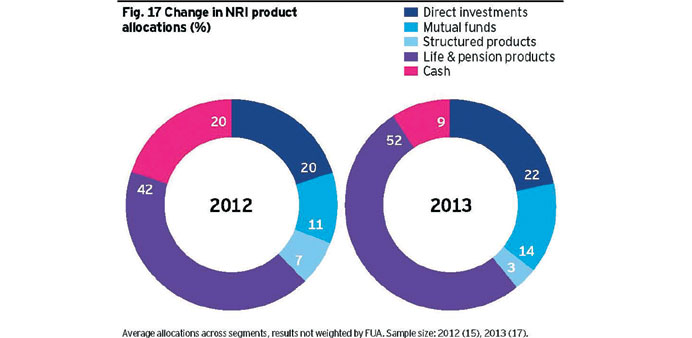
Non-resident Indian (NRI) investors in the Gulf region have opted to invest more in life and pensions products this year, moving away from cash deposits in India, according to a study by Invesco.
“NRI allocations to cash have fallen from 20% to 9% while allocations to life insurance products have risen to 52% from 42%,” the study said.
The combination of exchange rates, deposit rates and regulation encouraged NRI investors to put more cash on deposit in India in 2012, it said.
However, home market bias has reversed this year, reducing by 13% as rupee has fallen against dollar/dirham, and NRIs have invested more in dollar-denominated products in the GCC (Gulf Cooperation Council) than in rupee-based deposits in India.
Life insurance savings products are contractual products, which are more illiquid than cash, so a shift to life products is consistent with the year-on-year increase in NRI time horizons, it added.
The study said average expatriate investor time horizon rebounded from approximately five years in 2012 to over six years in 2013 with increases in all major customer segments, it said.
Time horizons amongst Western expatriates rose by just more than one year but the “most significant” changes were observed amongst Arab expatriates and NRIs, Invesco said.
NRIs stay in the region longer than any other expatriate group and for them, the main reason for leaving the GCC is redundancy (job loss), while for Arab expatriates, the most commonly cited reason is a change in family (or personal) circumstances.
The job market has been relatively stable over the last 12 months and as a result, there has been limited change in length of stay for NRIs but the ongoing unrest in the Middle East and North Africa region continues to impact personal circumstances for Arab expatriates, it said.
“Increasing time horizons are important for the asset management community because clients who invest for longer periods typically take more risk and increase their exposure to higher risk assets,” the study said.
In contrast to Arab expatriates, the increase in time horizon for NRIs is not driven by changes to their length of stay in the GCC, it said, adding in fact the primary driver of increasing time horizons is changes in attractiveness of investment opportunities in India versus the GCC.
The direct investments by NRIs constituted 22% in 2013 against 20% in the previous year; while mutual funds’ share was 14% (11%), structured products 3% (7%).