


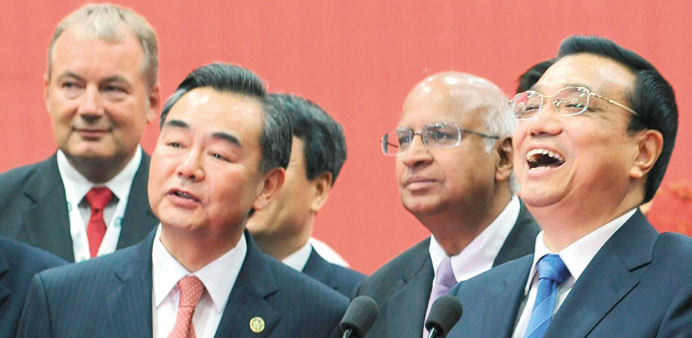
Chinese Prime Minister Li Keqiang laughs during a video conference with Chinese employees of Tata Group, at the Tata Consultancy Services (TCS) software facility in Mumbai yesterday.
Agencies/New Delhi
Visiting Premier Li Keqiang yesterday promised to open China’s vast domestic market wider to Indian businesses and narrow a gaping trade deficit, a longstanding irritant with New Delhi.
The trade push, which the countries say will supply “new engines” to lift the global economy, is part of efforts by the nuclear-armed powers to put a recent military dispute along their contested Himalayan border behind them.
“I am confident we have the ability to mitigate the trade imbalance between our two countries,” Li told business leaders in New Delhi, responding to Indian concerns over trade that is heavily skewed in China’s favour.
“The Chinese side is willing to provide facilities for more Indian products to access the Chinese market,” added Li, who chose to make India his first foreign stop after taking office two months ago.
China is India’s biggest trading partner, with two-way commerce totalling $67.83bn in the last fiscal year to March 2013, up from $2.1bn in 2001-02.
But India’s trade deficit soared to $40.77bn last year from just $1.08bn in 2001-02, Indian commerce ministry figures showed yesterday.
Li said he wants a “dynamic trade balance” as the Asian giants strive to raise two-way trade to $100bn by 2015 and called the two countries “huge markets with huge potential.”
But similar previous Chinese commitments have failed to narrow the gap.
“The two countries must now take corrective steps,” B G Verghese, fellow at the New Delhi-based Centre for Policy Research, said, adding the balancing process could take five to seven years.
“There must be market access on the Chinese side and the Indians must produce the manufactured goods the Chinese need,” he said.
In his speech, Li reiterated China’s desire to build trust with India after both sides agreed on Monday to work towards settling their long-running dispute over their still formally undefined border.
Ties have been dogged by mutual suspicion, the legacy of a brief 1962 border war. China also views the presence in India of Tibet’s spiritual leader the Dalai Lama, who campaigns for “genuine autonomy” for his homeland, as a serious irritant.
Li said China understands “balanced trade is crucial to good ties between the world’s two most populous countries” and that “a peaceful and stable South Asia is consistent with China’s development interests.”
“Only a dynamic trade balance is a sustainable trade relationship,” he said.
“We will support Chinese enterprises to increase investments in India and help Indian products have access to Chinese markets,” he said, as he also promised to help raise prosperity in the Asian region.
India is seeking Chinese participation in its special manufacturing zones or SEZs being set up under its National Manufacturing Policy which aims to sharply boost manufacturing to provide jobs for its growing army of young people.
Yesterday, the two countries signed deals to raise Indian access to China’s drugs market and promote trade in fish and meat products, billed by New Delhi as helping address China’s food security.
China’s trade commitment comes as both nations’ economies have slowed due to the global downturn and in India’s case to high interest rates, corruption scandals and government policy paralysis that have dampened business activity.
Li later travelled to the financial hub Mumbai where he visited the Tata Consultancy Services (TCS) global development centre in suburban Goregaon.
Tata Group chairman Cyrus P Mistry hosted Li and his delegation at the centre.
Li was given an overview of the Tata Group’s operations in China with special focus on the Jaguar Land Rover SUV and TCS’s growing investments and operations across the country.