


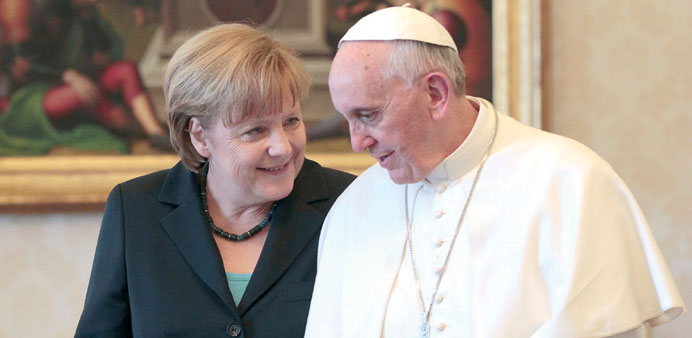
German Chancellor Angela Merkel met Pope Francis yesterday and, apparently responding to his criticism of a heartless “dictatorship of the economy”, called for stronger regulation of financial markets.
On Thursday, Francis appealed in a speech for world financial reform, saying the global economic crisis had made life worse for millions in rich and poor countries.
Merkel visited Rome for a few hours specifically to meet the pontiff and spoke with him privately in his library for 45 minutes, unusually long for a private papal audience.
She told reporters afterwards that the scandals and excesses criticised by Francis earlier in the week showed that vital checks and balances had not been functioning properly.
“Crises have blown up because the rules of the social market have not been observed,” she said, adding that tightening financial market regulation would be a main objective of the meeting of leaders of Group of 20 economic powers in September.
“We have made progress but we are nowhere near a point where we could say that the kind of derailment that leads to market crises could not happen again and so the issue will again play a central role at the G20 meeting this year,” she said.
“It is true that economies are there to serve people and that has by no means always been the case in recent years.”
Merkel, the daughter of a Lutheran minister, said she and Francis had spoken mainly about globalisation, the European Union and the role of Europe in the world.
“Pope Francis made it clear that we need a strong, fair Europe and I found the message very encouraging,” said Merkel, head of the Christian Democratic Union, which has a strong Catholic component.
In his first major speech about finance since his election in March, Francis had also urged states to take greater control of their economies and protect the weakest.
Merkel, who grew up in communist East Germany before the country was re-unified, said both she and Francis had “lived under dictatorships”, referring to the military junta that ruled the pope’s native Argentina from 1976 to 1983.
Meanwhile, opposition leader Peer Steinbrueck said Merkel’s focus on austerity in the eurozone is harming economic growth in Germany.
“Mrs Merkel seems of be the last defender of the interests of German taxpayers,” Steinbrueck told DPA in an interview.
“She imposes belt-tightening on other countries, sending them into a vicious circle which comes striking back at us as an export-dependent economy.”
Polls show Merkel consistently ahead of Steinbrueck when voters are asked whom they would prefer to lead their country, and predict the chancellor’s Christian Democrats (CDU) will beat his Social Democrats (SPD) in a general election in September.
“We are already feeling it: only 0.1% growth in the first quarter,” said the 66-year-old politician.
Merkel is facing mounting opposition from other eurozone countries over her focus on debt and budget deficit reductions. Spain, Italy and France would like to see a shift to growth and job creation. Merkel has said fiscal reform and growth are complimentary.
The currency bloc is in recession after data this month showed its economy shrank 0.2% in the first quarter, having contracted 0.6% in the final three months of 2012.
A meagre 0.1% growth rate posted by Germany failed to offset recessions in the eurozone’s other leading economies, such as Spain and Italy.