


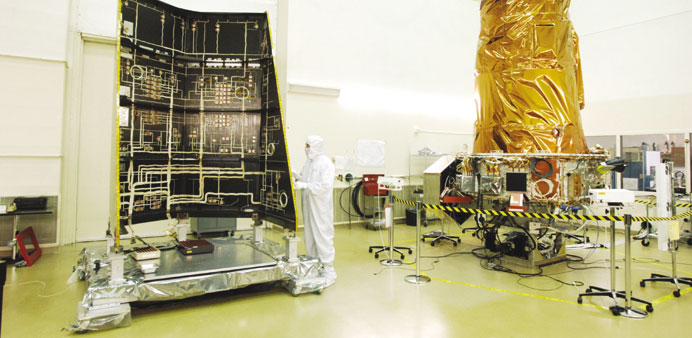
This photo provided by Nasa on Thursday shows the Kepler Space Observatory during assembly.
DPA/Washington
Nasa’s Kepler telescope, which has had a successful run identifying planets over the last four years, might have found its last.
The US space agency said on Wednesday that a critical piece of equipment that helps the craft maintain its position had failed.
Kepler has identified 132 confirmed planets and more than 2,000 potential planets, including a handful that look similar to Earth, since it was launched in 2009.
Earlier this week when Nasa tried to communicate with Kepler, it found the telescope had entered “safe mode”.
A series of tests found a problem with one of the four wheels that helps aim the craft.
Nasa officials said they were considering their options, including efforts to fix the wheel or find some other way to keep the telescope working.
Another of the four wheels had failed earlier, leaving it unlikely that the telescope will be able to maintain the accuracy it needs to collect information about distant planets.
However no decision had been made to end the mission’s data collection. Nasa said: “Even if data collection were to end, the mission has substantial quantities of data on the ground yet to be fully analysed, and the string of scientific discoveries is expected to continue for years to come.”
The Kepler space telescope is finely tuned enough to detect Earth-sized planets orbiting distant stars. The $590mn telescope programme has been scanning a large swath of the Milky Way galaxy, which contains about 4.5mn stars.
The most advanced cameras ever used in space are focusing on 100,000 to 150,000 stars deemed most likely to have orbiting planets.