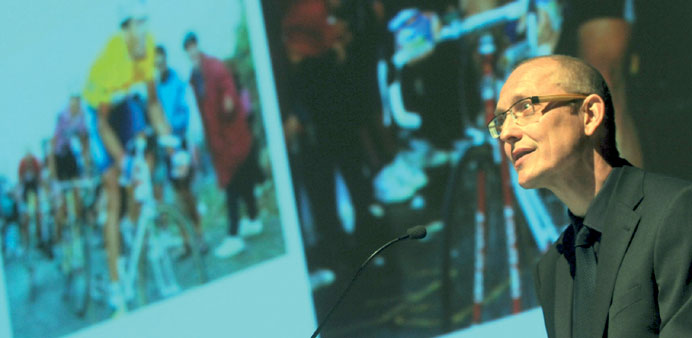
Prof Verner Moeller speaks at History of Doping and Anti-Doping Symposium at the Museum of Islamic Art yesterday. PICTURE: Jayan Orma
By Mikhil Bhat/Doha
The World Anti-Doping Agency (WADA) website gives a brief history of anti-doping. It says doping has existed since ancient times.
It also reveals that death of Danish cyclist Knud Enemark Jensen at 1960 Rome Olympics “increased the pressure for sports authorities to introduce drug testing”. Further it talks about how, in 1967, the “urgency of anti-doping work had been highlighted by another tragic death, that of cyclist Tom Simpson during the Tour de France”.
Put the two together, anti-doping perhaps actually set out to only safeguard public health. These days, it has snowballed into what looks like an endless pursuit of “clean” wins.
These and other important related issues are being discussed at History of Doping and Anti-Doping Symposium, which is being organised by Anti-Doping Laboratory Qatar in Doha. The two-day event, which began yesterday, features a host of speakers from various fields including, founding WADA president William Pound and author of various books on doping in cycling Prof Verner Moeller.
Moeller, who is a professor of Sport and Body Culture at Denmark’s Aarhus University and George Mason University in US, spoke about how doping has been prevalent in cycling since 1900s.
Fausto Coppi, the great Italian road cycling champion of the 1940s and 1950s, in an old interview said he used drugs “almost all the time”. Five-time tour winner Jacques Anquetil said it was impossible “to ride the Tour on mineral water”.
So why the clamour around anti-doping? “It is because we want to protect athlete’s health,” Moeller said.
According to Moeller’s presentation, average speeds in Tour de France actually increased in the times of intensified anti-doping campaign (1999-2005) — from 36.29 km/hr in 1978-1987 to 38.86 km/h in 1988-1998 to 40.39km/h.
“It’s like being between a rock and a hard wall. More doping checks mean that athletes move to drugs that do not get detected. As we have seen, these are also drugs that do the most harm to the body.”
So, what is the alternative? “First, an effort needs to be made to enlighten people about what drugs are and what it does to your body,”he explained.
“We have also noticed that penalties have not been a deterrent. So I would suggest a no-start rule. We need a health check, check testosterone level, hormone level, and if they are within reasonable limits, you are allowed to go.
“We will be in a situation which won’t be ideal but it would be realistic. These days, we store samples for years, and later we detect that there was a substance that’s prohibited now. So we hand the competition to number 2. But considering he has not been tested as much as the winner has been, then how can he be the winner. There is an uncertainty about who won.”
Listen to him more, and Moeller seems to be an advocate of actually having no anti-doping campaign at all, but he denies that.
“I am not saying educate and lower the bar, and let people do what they want. In the interviews I have conducted, I have spoken to athletes who have admitted to doping and those who have not. Those who admitted said that control is needed so that it doesn’t become a game of who dares the most. Because we want to win but also stay alive.”
Anti-doping, according to Moeller, “is basically about helping growth in the economy”.
“We live in a growth economy. To have the economy growing, we need new problems. Anti-doping is one of the problems that’s been invented 20 years ago. Since then, the economy in anti-doping has just gone off. Many people, bureaucrats are being used in tests and controls, and they are benefitting and that is perhaps why we would never get rid of anti-doping.”
On the second day of the symposium today, the likes of Prof Aishah A Latif, Dr Theodore Friedmann and Prof. Arne Ljungqvist will talk on topics including “Natural Substances for Performance Enhancement in Sport”, “Gene Doping” and “Forty Years Inside Anti-Doping”.