


By Joerg Taron
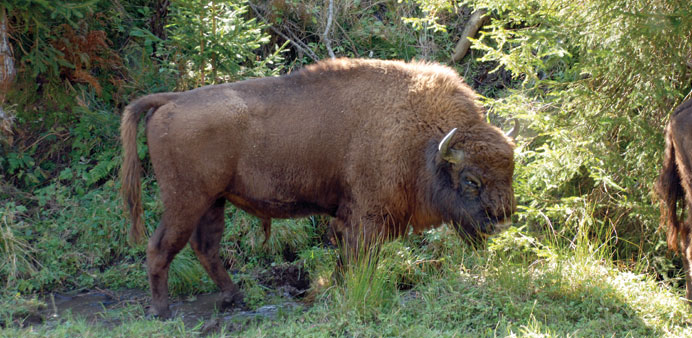
The European bison was on the verge of extinction in Germany less than a century ago, but now “the king of the forest” is free to roam once again.
After three years of preparing a herd from zoo animals, park rangers recently released eight of the beasts into the wild in the Rothaar Mountains in central Germany.
“We have been working on the project for nearly a decade and now we can finally take down the fences,” said Johannes Roehl of the European Bison World Wittgenstein acclimatisation site in Bad Berleburg.
The convincing to reintroduce Europe’s largest land mammals into Germany’s uplands was begun by an aristocrat from the region, Richard Sayn-Wittgenstein-Berleburg, who was able to stand up to local conservatism.
“Some people from the region were vehemently against the idea at the beginning,” explained Roehl.
Spokesmen for the tourism industry were especially concerned as they argued that the huge creatures, which can reach a weight of more than 800kg, would frighten hikers enjoying the mountains.
However, the fears turned out to be unfounded and opposition to the project has now dissipated.
“The tourist industry here is now using the European bison in its promotional campaigns, said Roehl.
Roehl says bison are not raging, trampling monsters, and will not damage the forest: “Naturally there were concerns that they would cause mayhem, but we have shown that they are calm beasts.”
The bison herd, headed by bull Egnar and lead cow Araneta, was acclimatised in a fenced area of 88 hectares.
Parts of their 4km fence have now been removed, but the animals are not expected to disappear permanently into the undergrowth outside, but to keep re-visiting, returning inside the familiar compound.
“We believe that they will confine themselves to the area around here, between 2,000 and 3,000 hectares in all,” said Roehl.
They are likely to keep coming back to a feed trough provided by bison ranger Jochen Born to ensure the animals remain well fed during the sometimes harsh northern European winters.
“I don’t believe that human contact with the animals will peter out, as scientists want to keep monitoring the project,” said Born.
“It is a bit like being the father in a family when the children finally leave home,” the ranger explained. “But they will be all right.”
Initially, rangers considered fencing in thousands of hectares of forest in the Rothaar Mountains to prevent the animals from roaming too far.
The idea of using a virtual fence was also considered whereby a sound alarm would activate if the bison approached the park perimeter and a small electric shock would be sent through an electric collar to deter the animal from continuing on its path.
“That would have been technically quite challenging and fortunately turned out not to be necessary,” said Roehl. Instead, just three of the animals wear collars with a GPS transmitter.
“In this way, we always know the location of the herd,” he explained. The herd is not completely self-governing. “We will have to continue to intervene in the herd structure,” said Roehl.
When the female offspring are old enough to mate, the bull will have to be replaced to prevent in-breeding. Even though there are nearly 4,000 European bison alive, all of them are descended from just 12 animals.
“The small genetic pool is a constant problem with European bison,” said Roehl.
The project, which receives federal and state funding, has so far cost in the region of 1.6mn euros ($2.1mn). The bison park in Wittgenstein has also played its part, attracting 15,000 fee-paying visitors since September 2012. — DPA