


|
Ecuador yesterday said it will continue to grant asylum to WikiLeaks founder Julian Assange at its London embassy after talks with Britain failed to achieve a breakthrough in the case. |
Foreign Minister Ricardo Patino said the Australian was prepared to stay at the embassy for another five years if necessary until a diplomatic solution was found, insisting there were no plans to smuggle him out “in the boot of a car”.
Patino was speaking after talks with British Foreign Secretary William Hague in London ahead of the anniversary tomorrow of Assange’s flight to the embassy.
The 41-year-old former computer hacker sought refuge on June 19 last year after a British court ordered his extradition to Sweden, where he is wanted for questioning over alleged sex crimes.
Britain has refused to grant Assange safe passage out of the embassy to Ecuador, so he remains indefinitely stuck in the modest apartment near Harrods department store.
Hague and Patino “agreed to keep channels of communication open, but made no breakthrough” during their 45-minute meeting, said a statement from the British Foreign Office.
“Ministers agreed that officials should establish a working group to find a diplomatic solution to the issue of Julian Assange, but no substantive progress was made,” it said.
“The foreign secretary (Hague) was clear once again that any resolution would need to be within the laws of the United Kingdom.”
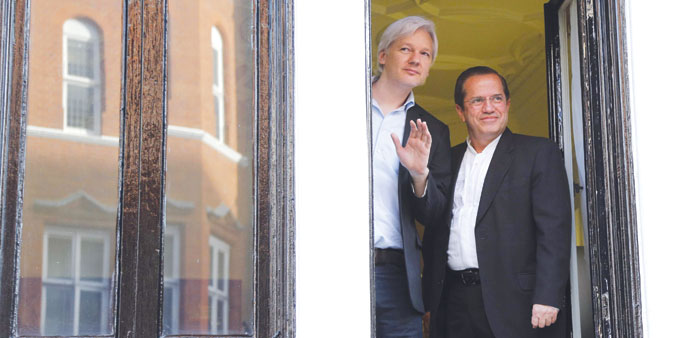
Patino met with Assange at the embassy on Sunday and they spoke through the night. He said the Australian was in “good spirits” despite his confinement, which requires him to use a sun lamp to make up for the lack of natural light, and exercise on a treadmill.
“He did not say anything about his health. He said he was strong enough to stay in our embassy for at least five years if he is not granted safe passage,” Patino said.
“I would consider it a total injustice if he has to spend more time in our embassy. I hope Assange will not grow old and die in our embassy - but we are defending human rights.”
Patino denied his country was blocking legitimate legal proceedings, saying Swedish prosecutors had been repeatedly offered the opportunity to question Assange at the embassy, but had refused.
He said Ecuador would not give up on the WikiLeaks founder - but nor would it turn to subterfuge to resolve the impasse.
“Assange is not going to escape from our embassy,” he said. He added: “When Assange leaves the embassy of Ecuador, he will leave through the main door—he is not going to go out the back, he is not going to go through a tunnel, he’s not going to go out in the boot of a car.
“He is going to go out the front, to our country, to freedom.”
Assange denies the allegations of sexual assault, saying they are politically motivated and linked to the release by WikiLeaks of hundreds thousands of classified US documents. He said he fears his extradition to Sweden would pave the way for his transfer to the US, where he could be prosecuted for the whistle-blowing website’s activities.
After his talks with Patino on Sunday, Assange said: “I remain immensely grateful for the support Ricardo, President (Rafael) Correa and the people of Ecuador have shown me over the last year.”
Despite the trouble over Assange, the Ecuadorian minister said his country would consider taking in another whistleblower who has fallen foul of the US authorities. He said that if Edward Snowden, the former CIA analyst who blew the lid on a vast US surveillance programme, wants to apply for asylum, “of course we will examine his request”.