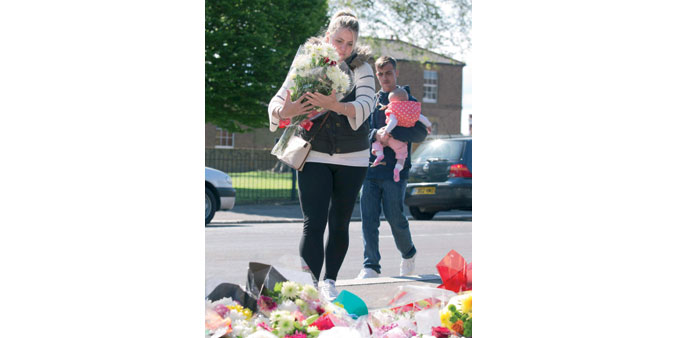
A woman arrives to lay a floral tribute outside Woolwich Barracks in London yesterday.
The killers’ apparent Nigerian family origins and claims on the BBC that one of the pair was arrested last year while attempting to travel to Somalia have led to intense speculation about the ideological motivation behind the brutal murder.
The possibility of a connection with the Al Qaeda-linked Al Shebaab group in Somalia, while unconfirmed, and the bloodied attacker’s video comments about women in an unspecified foreign country seeing killings in “our land” might point towards some overseas motivation.
A separate focus of attention will be any possible link to Boko Haram, the Nigerian Islamist militant group. It is engaged in a military conflict with Nigeria’s government so severe that a state of emergency was declared in three states last week with thousands of troops deployed in an attempt to regain control.
The militants reject all forms of western society — the name Boko Haram means “western education is forbidden” — and have become increasingly powerful since 2010, claiming an estimated 2,000 lives in a campaign of violence that counter-terrorism experts had already begun to fear might inspire potential attacks beyond Nigeria’s borders.
But as MI5 and Scotland Yard counter-terrorism officers continued to investigate the two men’s backgrounds yesterday, the strongest indications appeared to be that they are homegrown “lone wolves”.
The idea of beheading a soldier has been a terrorist objective for several years and led to the jailing of five men in a 2008 over a chillingly similar plot to murder a serviceman on video.
The Al Qaeda English language magazine Inspire and other militant websites — which between them are thought to have thousands of readers — also promote the idea, partly because the relative simplicity of carrying out such an attack can make it difficult to foil.
Such a danger, and the risk that militants either born in Britain, as Wednesday’s attackers are thought to have been, or resident here, might be inspired by Internet propaganda has long been a focus of MI5’s attention.