


AFP/Kandana
A hot cup of tea is better known as being soothing and relaxing, but Sri Lanka is now marketing its most profitable export as a luxury boost for the libido.
The tea industry is increasingly plugging Ceylon’s supposed aphrodisiac qualities in a bid to radically change perceptions of the brew, which manufacturers say can sell for less than water in some markets.
“We are highlighting the properties of tea that can give you an edge in the bedroom,” said Rohan Fernando, whose firm HVA Foods sells a small 60gm jar of premium Ceylon for $350.
“Tea has traditionally been the poor man’s drink. We want to be at the top-end of the supply chain,” he said.
The industry may not yet have hard medical proof of Ceylon’s performance-enhancing powers, but they have long been the stuff of legend among Sri Lankan tea lovers.
The brews known for their potency are the top-quality white teas, known as Silver Tips and Golden Tips, which are gaining popularity among well-heeled Chinese businessmen along with rich Saudis and Japanese, Fernando said.
Unlike orthodox teas, the white varieties are made with just the tender tea buds, which are sun-dried and carefully tended until they turn gold or silver in colour.
At his tea factory in Kandana town, north of the capital Colombo, Fernando held up a ceramic urn wrapped in black velvet and sealed with a gold ribbon, explaining that a cuppa is not only good for sexual health. The tea contains polyphenols, flavonoids and anti-oxidants - known to improve the immune system and blood circulation.
Leading tea maker Herman Gunaratne is also keen to promote such qualities in his rare “virgin white” tea, so called because it is untouched by human hands in production, unlike orthodox types hand-plucked from the tea bush.
The product retails at the Mariage Freres tea emporium in Paris for $88 for a 20gm box, the equivalent of $4,400 per kilo.
“My virgin white tea contains 10.11% anti-oxidants... This could be the highest level of anti-oxidants in any tea,” Gunaratne said.
“When your overall health improves, your sexual performance automatically increases.”
Tea is not indigenous to Sri Lanka, but after Scotsman James Taylor planted the first tea bush, Camellia Sinensis, in 1849, it became a primary export. Last year, tea brought in nearly $1.5bn to the country’s coffers.
Sri Lanka also conducts the world’s largest weekly tea auction where 5 to 6mn kg change hands. But the island may soon be reaching its maximum production capacity after exporting nearly 320mn kg last year.
Gunaratne is among the tea purists who want to guard Sri Lanka’s reputation as a maker of clean tea - product that is free of pesticide residue and other contaminants - and he is keen to see more high-end varieties rather than the traditional export of cheap bulk products.
“We need to re-brand tea,” he said. “We have the potential to increase our tea income
four-fold.”
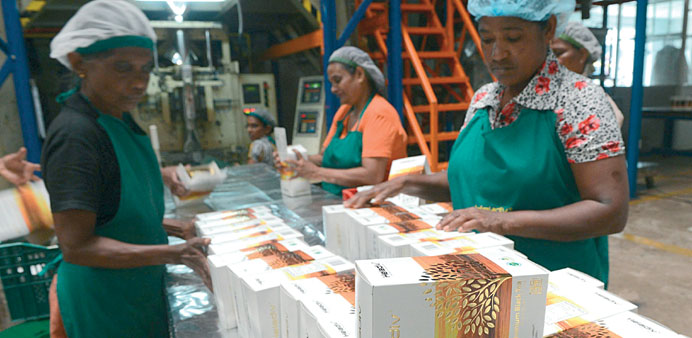
Workers pack tea at a factory in Kandana on the outskirts of Colombo.