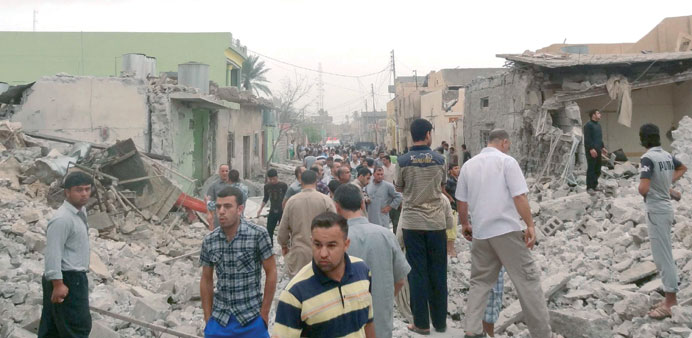
Residents stand amid rubble at the scene of the bombing in Tuz Khurmato yesterday.
Reuters/Baghdad
A series of bomb and gun attacks across Iraq killed more than 40 people yesterday, a day after over 70 died in violence targeting majority Shias that has stoked fears of all-out sectarian war with minority Sunnis.
Nearly 300 people have been killed in the past week as sectarian tensions, fuelled by the civil war in neighbouring Syria, threaten to plunge Iraq back into communal bloodletting.
Ten years after the US-led invasion that toppled Saddam Hussain, Iraq’s Sunnis, Shias and Kurds have yet to find a stable power-sharing deal and violence is again on the upswing.
In the biggest single incident yesterday, a car bomb exploded near a Sunni mosque in the Abu Ghraib area of western Baghdad killing 11 people and wounding 21, police and medics said.
“I heard a powerful bang and a fireball near the main gate of the mosque,” said Uday Raheem, a policeman whose patrol was stationed near the mosque.
“We held back a while fearing a second explosion and then rushed to the blast location. The bodies of worshippers were scattered and some were shouting for help, bleeding to death.”
Another bomb outside a cafe in the Doura district of southern Baghdad killed six more and wounded 18.
In Diyala province northeast of the capital, at least eight people, including two policemen, were killed in bombs and shootings, and in Kanaan, also to the northeast, two roadside bombs detonated in quick succession claiming three lives.
In the north of the country, three roadside bombs exploded near a livestock market in the ethnically-mixed city of Kirkuk, killing six people and shredding the bodies of humans and animals alike.
Mahmoud Jumaa, whose cousin was killed in the multiple bombings, appeared bewildered by their random nature.
“I heard the explosions, but never thought this place would be targeted since these animals have nothing to do with politics, nothing to do with sect, nothing to do with ethnicity or religion,” he said.
Kirkuk is in a disputed oil-rich swathe of Iraq claimed both by the Shia-dominated government in Baghdad and ethnic Kurds who run their own autonomous administration in the north.
Two car bomb blasts killed three people in a residential part of the town of Tuz Khurmato, also in the disputed area.
North of Baghdad, a suicide bomber killed three soldiers at a checkpoint in Tarmiya, police and medics said, and in Khalis gunmen broke into a house and killed and man and his wife, both of them Sunni Muslims.
Sunnis who resent their treatment by Shia Prime Minister Nuri al-Maliki’s government have staged mass protests since December. Sunni militants, some of them linked to Al Qaeda, have exploited the unrest, urging Sunnis to take up arms.
More than 700 people died violently in April, according to the UN, the highest monthly figure in almost five years. Iraq suffered a frenzy of Sunni-Shia violence in 2006-07, when monthly death tolls sometimes topped 3,000.
PM orders shake-up of senior security officers
Iraqi Prime Minister Nuri al-Maliki ordered a shake-up of senior security officers yesterday. “After consultation with security officials, the commander-in-chief of the armed forces, Prime Minister Nuri al-Maliki, today (Tuesday) issued orders ... for changes in the operations commands and the leadership of the divisions,” a statement on Maliki’s website said. One of those changes was to sack Staff Lieutenant General Ahmed Hashem, the head of the Baghdad Operations Command, which is responsible for security in the capital, a senior official told AFP. The shake-up comes a day after Maliki said he would change the country’s security strategy as well as top personnel.