


Scientists from the Environmental Studies Centre of Qatar University and the School of Ocean Sciences at Bangor University in the UK have initiated a project to map the entire seabed within Qatari waters. This is the first time such a project has been conducted in the Arabian Gulf.
The first phase of mapping, using seabed cameras and sonar imaging, was conducted on the RV Janan, the new 43m multipurpose research vessel of Qatar University.
This is one of the joint research projects addressing some of the challenges facing rapidly growing Gulf states such as Qatar. The study aims to balance growth against environmental conservation and sustainable management of the region’s unique marine ecosystems and resources.
It also emphasises that the pressures of development and climate change need to be managed without jeopardising existing valuable natural resources which support industries such as fishing that are important to food security. The project will provide information to develop policies which will safeguard the sustainability of Qatar’s marine resources.
A desire to ensure the sustained and healthy survival of a Qatari fishing industry is also behind a recently announced research programme funded by the Qatar National Research Fund ( QNRF). Under the programme, the Centre for Applied Marine Sciences at Bangor University and the Environmental Studies Centre at Qatar University will work with the Ministry of Environment Department of Fisheries to study how different seabed environments in the deep Gulf waters support different fish communities.
Qatar’s inshore and coastal marine habitats such as seagrass and mangroves also provide important nursery grounds for fish and are therefore an economically important resource to the fishing industry. Ongoing work is studying the ecology of these coastal ecosystems to better understand how they function in the Arabian Gulf’s unique marine environment and to develop an evidence base to inform strategies for their future management.
Dr Lewis Le Vay of Bangor University said: “The Gulf region has seen extensive and rapid modification of large areas of coastal habitats for developments in recent years, with the loss of over 40% of natural coastline in some Arabian Gulf states, as well as offshore impacts and construction of artificial islands. The question is how and to what extent such developments affect fisheries. We understand the impact of the loss of shallow nursery grounds, but much less is known about condition of deeper offshore habitats which also support large numbers of fish.”
In addition to joint research spanning fisheries, aquaculture, oceanography and marine geochemistry, the partnership will provide postgraduate training opportunities, as well as an accessible resource of world-leading expertise and facilities to conduct multi-disciplinary research and consultancy in Gulf waters. Two new PhD research projects starting in 2013 will assess long-term changes in marine pollution levels in the Gulf.
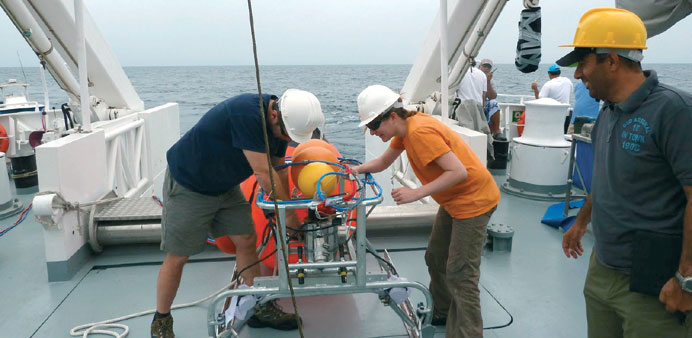
Setting camera sledge for seabed mapping.