


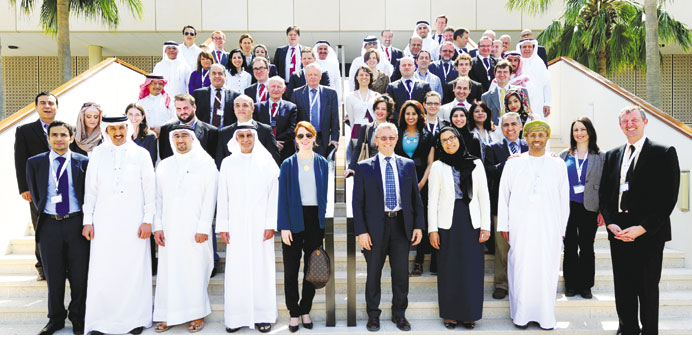
The event attracted leading academics, ambassadors, political advisers and other experts.
Foreign policy relations between the GCC and European Union (EU) comprised the subject of a two-day international symposium, organised by Qatar University (QU), Gulf Research Centre and Institute for European Studies, Vrije Universiteit Brussels, which concluded yesterday.
The event - promoting an EU-GCC dialogue on foreign policy issues - attracted leading academics, ambassadors, political advisers and other experts in the fields of politics, government, economics, foreign policy and security from Europe and the Gulf to discuss various issues. These included the current status of EU-GCC relations, global governance, non-proliferation, political stability in transition countries post-Arab Spring, securing the transition in Yemen and handling the crisis in Syria.
It was opened by Dr Eiman Mustafawi, QU dean for arts and sciences; Dr Abdullah Baabood, director of QU’s Gulf Studies programme; Dr Christian Koch, director of Gulf Research Centre Foundation in Geneva; and Prof Joachim Koops, director of Global Governance Institute and head of international affairs at Vesalius College, which operates in association with Vrije Universiteit in Brussels.
“The conference is an excellent opportunity to build on strong bilateral relations to advance mutual and strategic interests between the EU and the GCC,” said Dr Mustafawi.
“We are honoured to host the conference in Qatar, sharing expertise and hearing experts in the region put forward their perspective of the relationship and how it can be strengthened.”
“This has been a really fruitful conference, with lots of frank discussions on topics of strategic importance to the region and beyond. There are some significant points that can be taken away from here and worked on, to the mutual benefit of both organisations,” said Dr Baabood.
Dr Koch and Prof Koops thanked QU as host, the joint partners for organising the conference and all the delegates for their willingness to share knowledge and build on improved collaboration in the future.
The purpose of the workshop, which operated under Chatham House Rule, was to use headline topic papers as a platform for a frank and informed discussion on the issues, particularly getting a GCC perspective of the relationship and to suggest future steps for both sides, which would help strengthen co-operation. The event was part of a series of conferences examining relations between the institutions of the EU and GCC.
The conference forms part of a comprehensive programme of workshops, seminars and guest lectures organised by the Gulf Studies programme at CAS, establishing QU as a regional centre of excellence in all aspects of international relations pertaining to the Gulf.
QU’s Gulf Studies Masters programme is one of only two in the world, and the only of its kind in the region that offers a detailed study of the politics, economics, history, literature, international relations, security, the energy industry, ecology and culture of the Gulf.