


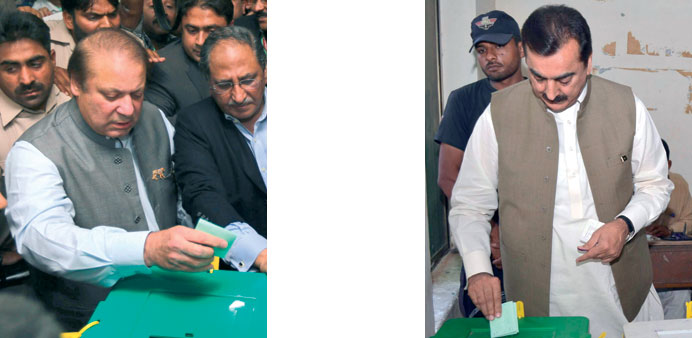
Former Pakistani prime minister Nawaz Sharif and Yousaf Raza Gilani cast their ballot during parliamentary elections yesterday.
Reuters/Islamabad
The parties of former prime minister Nawaz Sharif and cricketer-turned-politician Imran Khan appeared to be well ahead of their rivals in Pakistan’s election, according to a partial count of votes cast yesterday.
The election, in which 86mn people were eligible to vote, will bring the first transition between civilian governments in a country ruled by the military for more than half of its turbulent history.
Despite pre-election violence, and attacks yesterday which killed at least 17 people, millions turned out to vote.
The partial count showed that while Sharif was in the lead, his party could lose 15 of its seats in the critical province of Punjab to Khan, whose emergence on the political stage has up-ended a system dominated by two parties.
Television channels showed Khan’s party was ahead in more than 50 of the 272 seats in the election.
Khan, Pakistan’s best-known sportsman who led a playboy lifestyle in his younger days, is seen by many as a refreshing change from the dynastic politicians who long relied on a patronage system to win votes.
His Tehrik-e-Insaf (PTI) appeals mostly to young, urban voters because of his calls for an end to corruption, a new political landscape and a halt to US drone strikes on Pakistani soil. About one-third of the country’s population is under the age of 30.
Sharif’s party, the Pakistan Muslim League - Nawaz (PML-N), looked set to win the most seats in parliament but Khan could deprive it of a majority and dash Sharif’s hopes of a return to power 14 years after he was ousted in a military coup, jailed and later exiled.
The strong performance of Sharif and Khan will likely deal a blow to the outgoing Pakistan People’s Party (PPP), placing it third.
Power in Pakistan has for decades alternated between the PML-N and the PPP, whose most prominent figure is President Asif Ali Zardari, widower of assassinated former premier Benazir Bhutto.
Opinion polls have suggested that disenchantment with the mainstream parties could mean that no one group emerges with a parliamentary majority, making the next government unstable and too weak to push through much-needed reform.
Voters were electing 272 members of the National Assembly.
To win a simple majority, a party would have to take 137 seats.
However, a further 70 seats, most reserved for women and members of non-Muslim minorities, are allocated to parties on the basis of their performance in the contested constituencies. To have a majority of the total of 342, a party would need 172.
Pakistan’s Taliban, who are close to Al Qaeda, have killed more than 120 people in election-related violence since April. The group, which is fighting to topple the US-backed government, regards the election as un-Islamic.
More bloodshed marred election day. A bomb attack on the office of the Awami National Party (ANP) in Karachi killed 11 people and wounded about 40. In Baluchistan, four died in a gunbattle and elsewhere gunmen on a motorcycle opened fire near a polling station, killing two people, police said.
The main issues are the tanking economy, an appalling energy crisis that causes power cuts of up to 20 hours a day, the alliance in the US-led war on Islamist militants, chronic corruption and the dire need for development.
Despite the searing heat, many went to the polls excited about the prospect of change in a country that is plagued with Taliban militancy, a near-failed economy, endemic corruption, chronic power cuts and crumbling infrastructure.
“The team that we elect today will determine whether the rot will be stemmed or whether we will slide further into the abyss,” prominent lawyer Babar Sattar wrote in The News daily.
Sharif voted in Lahore, driven in a bulletproof vehicle and greeted with roars of “long live the lion” from supporters using his nickname.
“I am confident that tonight we will start receiving good news from across the country,” Sharif told reporters after casting his vote.
There were festive scenes in Lahore where cars, motorbikes and rickshaws festooned with party banners blared out music, while voters draped in flags shouted slogans, an AFP reporter said.
“We’re really enjoying this moment—people are very much happy about the chance to have change,” said Rashid Saleem Butt, 50.
Earlier, queues formed outside polling stations in Pakistan’s main cities where people spoke enthusiastically about exercising their democratic right and voting for change, although some people expressed nervousness about security.
“People have been up all night, actually I haven’t slept, a lot of my friends haven’t slept. People just wanted to come out and do this, because we never had this chance,” said Natasha Ejaz, a singer, in Islamabad.
Voting in Pakistan’s financial hub Karachi was marred by allegations of rigging from rival parties, while the Taliban targeted a candidate for the Awami National Party (ANP), an ally of the outgoing government.
The target, Amanullah Mehsud, escaped unhurt, police said, but 11 other people were killed, including a small child, and around 40 people wounded.
President Zardari
casts vote by post
President Asif Ali Zardari cast his vote in his hometown of Nawabshah through postal ballot yesterday.
However, PPP Chairman Bilawal Bhutto Zardari will remain in Dubai and not cast his vote. He is reported to have been advised not to return to the country because of security threats.
“The president cast his vote today and it will be received by the Election Commission,” President Zardari’s spokesman Farhatullah Babar said. The Election Commission (ECP) has already rejected the application of Bilawal to cast his vote through postal ballot. According to the Representation of People Act 1976, only government officials, prisoners, army personnel and those who are engaged by the ECP for election duty can cast their votes through postal ballot.
1 Supporters of the Pakistan Muslim League - Nawaz (PML-N) gather at the party headquarters after polling stations closed on election day in Lahore yesterday.
2 Supporters of Pakistani cricketer-turned-politician and leader of the opposition party Pakistan Tehreek-e-Insaf (PTI), Imran Khan, flash victory signs after parliamentary elections in Lahore.