


|
|
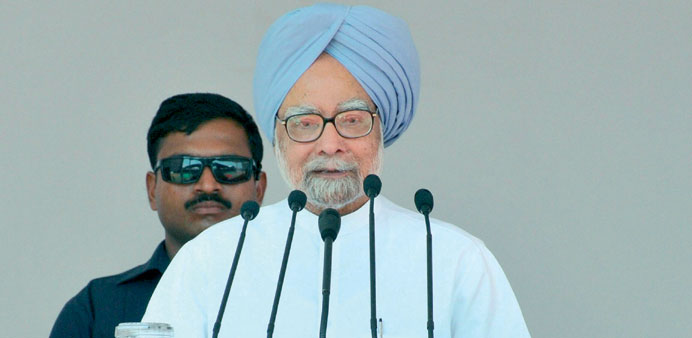
Prime Minister Manmohan Singh yesterday pledged to crack down on corruption in the defence sector after a string of recent graft scandals left his government facing renewed calls to step down.
Singh said he was committed to making the process of buying arms and other military hardware more “transparent, smooth, efficient and less vulnerable to unethical practices.”
“Adequate defence preparedness is critically dependent on sound defence acquisition policies,” Singh said in Gurgaon, a satellite city of New Delhi, where he laid the foundation stone for India’s first defence university.
“We have paid close attention to this and have continually reformed those policies,” he said. “We will continue to seek the highest standards of probity in defence acquisition.”
The government said in March it planned to draft new arms procurement procedures in the wake of a corruption scandal involving a contract to buy Italian helicopters.
Public anger over alleged bribes paid by Italian company Finmeccanica to secure a $748mn contract for 12 helicopters forced New Delhi in February to order an investigation and stall the defence deal.
The probe into the huge chopper deal has already seen police raid the home of the former air force chief and a “preliminary enquiry” report has linked four firms, four Westerners and seven Indians to the bribery allegations.
Italian prosecutors suspect that kickbacks worth around €50mn ($64mn) were paid to Indian officials to ensure Finmeccanica’s British unit AgustaWestland won the contract, according to Italian media reports.
New Delhi put payments to Finmeccanica on hold and threatened to cancel the deal if any wrongdoing was uncovered. India has already received three of the choppers. The rest were to be delivered by the end of 2014.
The Congress Party, up for re-election in May next year, has been hit by a string of scandals. Two ministers resigned this month, after one was accused of interfering in a graft probe and another linked to a bribery allegation.
The defence scandal erupted at a time when the government was already fighting off the national auditor’s charges that its cut-price sale of telecom spectrum and allocation of coalfields cost the exchequer billions of dollars.
The controversy paralysed parliament and derailed measures to further open up the heavily state-controlled economy, as growth plunged to a decade-low of 5% in the last financial year.
An opinion poll by the CNN-IBN television network released on Wednesday showed 67% of respondents saying the government had lost its credibility due to multiple corruption scandals and 61% saying Singh should exit.
The prime minister also said the government was also paying close attention to indigenisation of defence procurement, and was committed to taking further steps to stimulate the development of the domestic defence industry, including the Indian private sector.
“This is important not only to enhance our security, but also to spur industrial development and economic growth of our country,” he said.
The prime minister said the country must fully utilise the sophisticated management and technological capacities that were already with the private sector, including in the defence field, not just for production but for defence research and development.
He said the country’s deterrence capabilities had matured over the last nine years and the country was better equipped to deal with non-conventional threats, especially in the cyber and space domains.
Singh also said there is need for reorienting the country’s strategic thinking and reappraising its higher defence organisations.
The prime minister said India faces the entire spectrum of security challenges as it lies in a difficult neighbourhood.
He said India had today unprecedented access to high technology, capital and partnerships and had also sought to assume responsibility for stability in the Indian Ocean region.
“We are well positioned, therefore, to become a net provider of security in our immediate region and beyond.”